
Explore
Intelligence
Essential Planning Guide
Kagbhushandi Tal Trek — Complete Guide (2026)
Vibe & Scenery
The Experience
Introduction
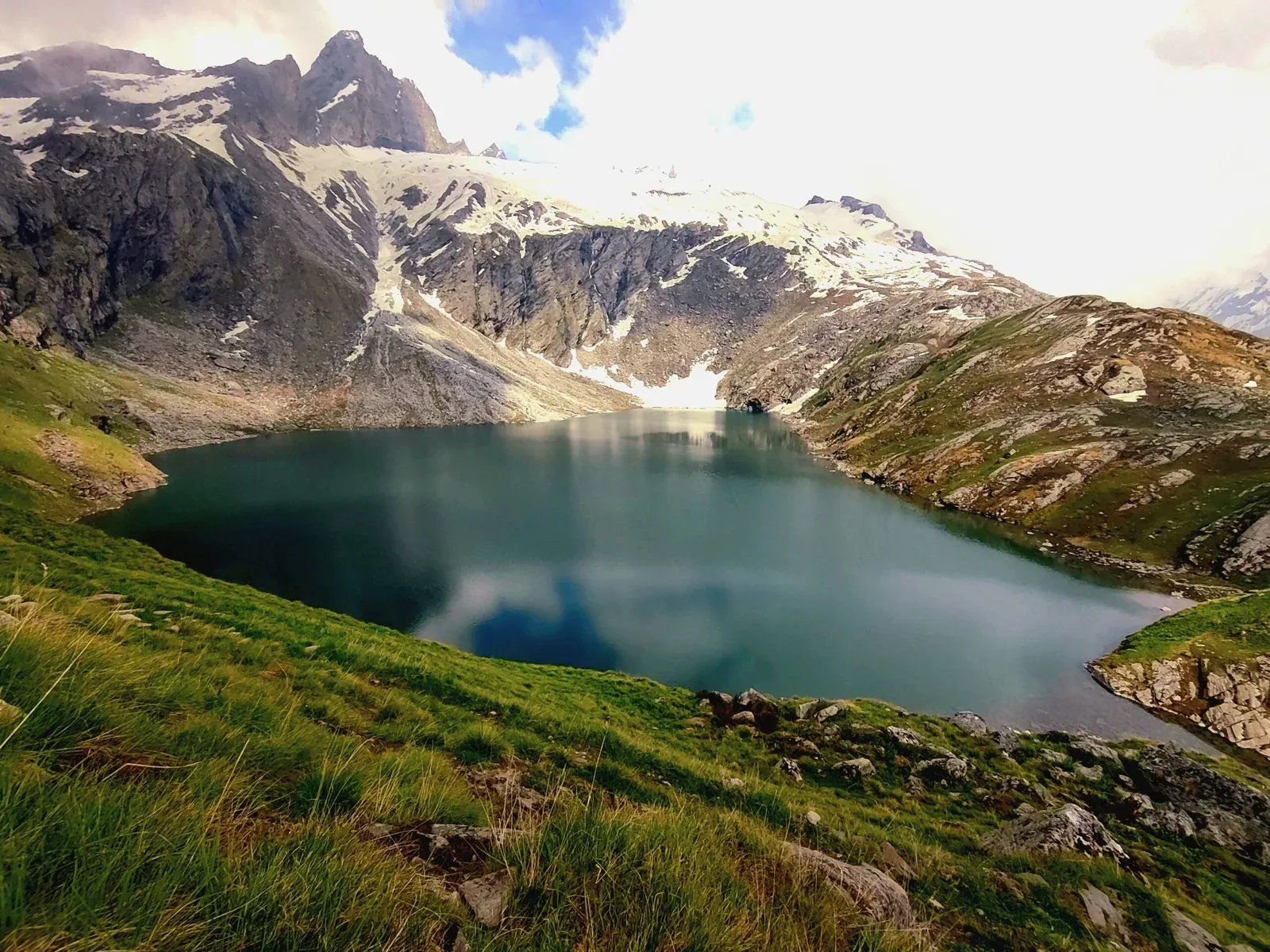
Kagbhushandi Tal is a remote alpine lake situated beneath Hathi Parbat in the Garhwal Himalayas and revered in Hindu mythology as the meditation place of the sage Kakbhushundi. Beginning from the Govindghat region, the route gradually leaves the popular Valley of Flowers corridor and enters far quieter alpine terrain.
The expedition traverses steep mountain slopes, extensive boulder fields, glacial moraines, and high passes before reaching the emerald-colored lake surrounded by rugged peaks. Weather conditions can change rapidly, and the upper sections require confident movement over rough mountain terrain.
Combining mythology, remote wilderness, and demanding high-altitude trekking, Kagbhushandi Tal is best suited for experienced trekkers comfortable with long days in isolated Himalayan environments.
Quick Facts
Duration
Max Altitude
Difficulty
Best Time
Trek Distance
Trail Atmosphere
Stargazing
Class 1 Dark Sky
Scent Profile
Silence Level
~10 dB
Vertigo Factor
3 / 10
Iconic Spots
Kankul Khal Descent
Environment
Nature & Culture
Flora & Fauna
Flora
Fauna
Legend has it that Lord Rama discussed cosmic truths with Kakbhushundi (immortal crow) at this very lake. Dropping garbage here is a severe local offense.
— Local folklore
Spiritual & Cultural Significance
Believed to be the cosmic residence of Kakbhushundi (crow sage).
🕐 Shrine Timings: N/A
Temple Protocols
- •Complete sobriety
- •Leave no trace purity
Technical Details
Challenge & Preparation
Primarily a altitude exposure and cardio demand challenge
A demanding expedition that balances altitude exposure and cardio demand.
Personal Readiness
Am I ready?
Planning
Logistics & Trail Intel
Getting There
Route to Base
Bus/Cab from Rishikesh directly up the NH-58 Badrinath highway
Base Village
Bhyundar / Govindghat
8,500 ft
Last ATM
Joshimath
Nearest Medical Facility
Joshimath Army Hospital
Mobile Signal
Total dark zone for 5 days.
Water Sources
Flowing streams near camps, but strictly treat/boil everything.
Charging
Zero charging after Govindghat.
For Drivers
Road Condition
The NH-58 is very well maintained but heavily trafficked by Badrinath pilgrims.
Joshimath
Trail Culinary & Diet
Don't miss the N/A
Buy specialized diet items at Joshimath
The Content & Remote Hub
No DronesStrictly illegal inside Nanda Devi Biosphere and near Badrinath airspace.Top Vlog Spots
Video Calls
none
Est. 20 Mbps
UPI Reliability
4/10
Base WiFi Available
Permits and Regulations
Permits from the Nanda Devi Biosphere Forest Department at Joshimath/Govindghat are required. Because it is highly remote, the DFO often requires proof of a certified guide before issuing.
Learn more about how we vet operators and ensure transparency on our why MountRoutes page.
Packing List
Advanced Navigational Gear
- Offline GPS device (The trail is non-existent past Raj Kharak)
- Double trekking poles (Vital for the boulder hopping over the glacier)
- Microspikes (Crucial for crossing Kankul Khal in early summer)
High-Alpine Clothing
- Gore-Tex Hardshell pants and jacket (The Bhyundar valley channels massive, sudden thunderstorms)
- Premium Down Jacket (-15°C rating)
- Waterproof gaiters
Survival Essentials
- Expedition Grade Sleeping Bag (-15°C limit)
- Complete First Aid / AMS kit (Diamox)
- Water purification tablets (Glacial runoff must be treated)
Deep Dives
Explore Further
Editor's Notes
Crows (Kakbhushundi) literally circle the lake daily. Do not feed them or disturb the area, as local porters hold the location in extreme spiritual reverence.
Explore In Detail
Day by Day Itinerary
7-day route reaching 15,000ft. Covers 58km of varied terrain.
→ See full itinerary with altitude profileDifficulty & Fitness
Rated challenging. Extremely rugged. Once you leave the tree line on Day 3, there is no defined path. You are walking over raw glacial moraine and massive boulders to reach the pass.
→ See difficulty breakdown and fitness guideCost & Pricing
Packages range from ₹16,000 to ₹22,000. Inclusions and hidden costs vary by operator tier.
→ See full cost breakdownFrequently Asked Questions
Is this the same trail as the Valley of Flowers?
Only for the first day. You drive/trek from Govindghat to Bhyundar village, but instead of continuing towards Ghangaria, you cut sharply East into a completely wild, unmapped valley.
Why is the lake so famous?
Aside from its vivid emerald color, mythology dictates that it is the home of Kakbhushundi (the crow sage). You will frequently see large ravens and crows congregating around the freezing waters, adding to the mystique.
Can beginners do this?
Absolutely not. This is a severe wilderness trek. There are no tea houses, no defined trails on the upper sections, and it requires crossing a 15,200 ft pass over massive boulders.
Is there mobile connectivity?
None. Your phone will lose signal permanently after leaving the main Bhyundar/Govindghat corridor.
Are there bears?
Yes. The dense oak and rhododendron forests below the tree line are prime Himalayan Black Bear territory. Do not keep food in your tents.
Can I do it alone?
It is highly dangerous to attempt solo. The path over Kankul Khal is unmarked boulder-scree. A local guide from Bhyundar or Joshimath is essentially mandatory to find the route.
What peaks will I see?
The lake sits directly beneath the massive rock wall of Hathi Parbat. You also get incredible views of Chaukhamba, Neelkanth, and Nar-Narayan peaks.
Are mules allowed?
Mules cannot cross the boulders over Kankul Khal. You must hire specialized local porters for the upper sections.
Where does the trek end?
It is typically a crossover. You start at Bhyundar, cross Kankul Khal to Kagbhushandi Tal, and descend the other side down the Farkia valley to exit near Vishnuprayag/Joshimath.
Is camping equipment provided?
There are no camps. Your expedition must carry all logistical gear, food, and fuel from the roadhead.
Still deciding?
Compare routes side-by-side to find the perfect match for your fitness, dates, and budget.
Everything you need to know, in one place. Someone else in your group needs to see this.
Planning Kagbhushandi Tal Trek?
Get route conditions, operator updates, and season windows before booking.
Don't miss out! Follow us for route updates@mountroutes|LinkedIn
No spam. Only useful trek updates.
Ready to walk this route?
You’ve read the guide, now find the perfect local team to take you there. Compare our verified list of operators.
Compare verified operators