
Explore
Intelligence
Detailed Route
Kalindi Khal Expedition Itinerary — Day by Day Route & Camps
A 12-day savage crossing from the holy source of the Ganges at Gangotri to the sacred shrine of Badrinath, navigating the massive Chaturangi and Sweta glaciers.
Standard RouteThis is the baseline pacing strategy for this expedition. Expedition leaders frequently modify rotation schedules, add reserve weather days, or adjust high camps based on real-time mountain conditions. Consult the operator's expedition dossier for their precise approach.
Duration
15 Days
Total Distance
99 KM
Max Altitude
19,521 FT
Trek Type
linear
Permits Required Before You Go
Permit Cost
Where to Get
IMF Delhi / DFO Uttarkashi
Documents
Extensive Mountaineering Resume, Specialized Alpine Insurance, Medical Clearances
Foreign Nationals
Extremely difficult. The route touches the sensitive Tibetan/Chinese border and requires X-Visa and Home Ministry clearance months in advance.
Foreigner Process
Requires intense Home Ministry and IMF clearance months in advance.
Nearest Embassy Hub
New Delhi
One-Way Traverse Logistics
⚠️ Point of No Return
After Day 8, evacuation is only possible forward towards the destination valley.
Day by Day Breakdown
Camp Alt
10,000 ft
Day Gain
+8,000 ft
Drive Dehradun to Gangotri
A massive 10-hour drive plunging deep into the Garhwal Himalayas. The town of Gangotri sits at 10,000ft, initiating the first stage of acclimatization.
Key Landmarks
Staying At
The urban environment of Dehradun is replaced by dense forests and deep river valleys, eventually culminating in the alpine town of Gangotri.
Camp Alt
12,450 ft
Day Gain
+2,450 ft
Trek Gangotri to Bhojbasa
Walk the relatively well-trodden pilgrim trail toward the source of the Ganges. The tree line vanishes after Chirbasa, placing you in a desolate high-altitude desert kind valley.
Key Landmarks
Staying At
Vegetation gives way to barren glacial debris as the route enters the expansive moraine basin and ablation zone of the Gangotri glacier basin.
Field Notes
KEY ACTIONRiver Crossings
Plan to cross early in the day before snowmelt swells the water levels. Unclip backpack waist belts before crossing.
Camp Alt
14,200 ft
Day Gain
+1,750 ft
Trek Bhojbasa to Nandanvan (via Gomukh)
The trail vanishes. You reach Gomukh (the ice cave birth of the Ganges) and step directly onto the massive Gangotri Glacier. Navigate hard ice, moraine and glacier debris to reach the Nandanvan meadow, camped directly beneath the spire of Mt. Shivling.
Key Landmarks
Staying At
The rocky valley floor narrows into a heavily crevassed glacial basin. The environment opens up at Nandanvan to reveal a high-altitude meadow situated directly beneath Mt. Shivling.
Field Notes
Use Trekking Poles
Trekking poles are highly recommended to save your knees on the descent.
INFOSlower Progress
Progress will be significantly slower and more taxing on your ankles than trail distance suggests.
Camp Alt
14,200 ft
Day Gain
0 ft
Today's Objective
☕ Acclimatization & Recovery
Mandatory rest day. By climbing 500 feet up the ridges toward Tapovan and returning to camp, you force your body to build red blood cells.
Key Landmarks
Staying At
The environment remains fixed at the vast alpine meadow of Nandanvan. Nandanvan sits between the Gangotri Glacier and the surrounding mountain walls.
Camp Alt
16,000 ft
Day Gain
+1,800 ft
Trek Nandanvan to Vasuki Tal
A traverse along the edge of the Chaturangi (Four-Colored) glacier. The air thins noticeably as you crash through the 16,000 ft barrier. Camp beside the half-frozen Vasuki Tal.
Key Landmarks
Staying At
The rugged alpine terrain opens up to reveal a spectacular high-altitude glacial tarn, serving as a critical hydrological node in the upper watershed.
Field Notes
KEY ACTIONRoped Travel
Requires roped glacier travel.
KEY ACTIONStart Early
Start before sunrise to ensure snow bridges remain solid.
KEY ACTIONHelmet Mandatory
Helmet mandatory. Move quickly and quietly through the rockfall zone without stopping to rest.
Use Trekking Poles
Trekking poles are highly recommended to save your knees on the descent.
INFOSlower Progress
Progress will be significantly slower and more taxing on your ankles than trail distance suggests.
Camp Alt
16,800 ft
Day Gain
+800 ft
Trek Vasuki Tal to Khara Pathar
A short but agonizing climb. The altitude reduces walking pace to a crawl. You are surrounded entirely by towering peaks of ice and rock; no vegetation exists.
Key Landmarks
Staying At
The rugged alpine terrain opens up to reveal a spectacular high-altitude glacial tarn, serving as a critical hydrological node in the upper watershed.
Field Notes
KEY ACTIONHelmet Mandatory
Helmet mandatory. Move quickly and quietly through the rockfall zone without stopping to rest.
Use Trekking Poles
Trekking poles are highly recommended to save your knees on the descent.
INFOSlower Progress
Progress will be significantly slower and more taxing on your ankles than trail distance suggests.
Camp Alt
18,000 ft
Day Gain
+1,200 ft
Trek Khara Pathar to Sweta Glacier
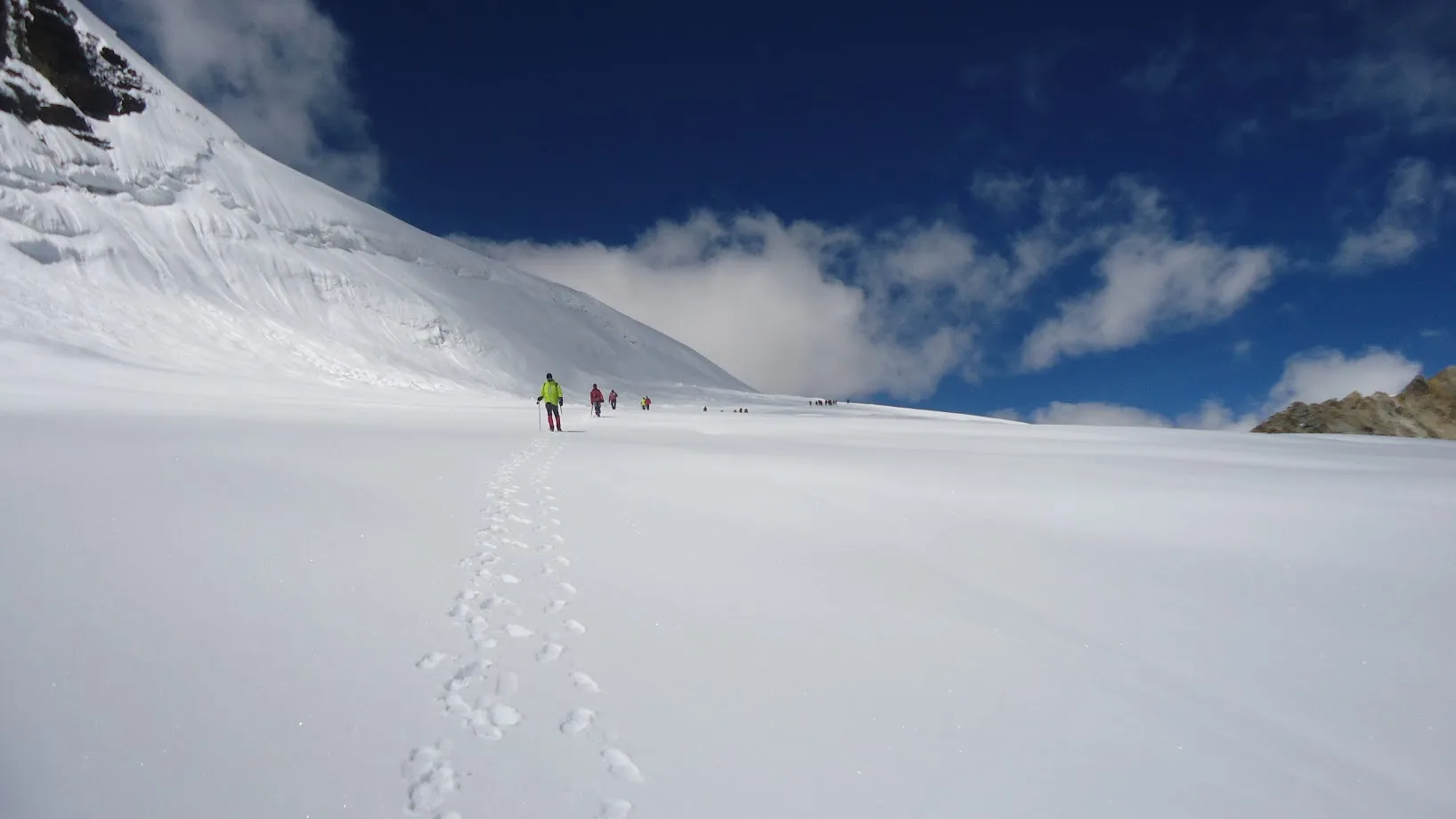
You now pitch tents directly on the frozen, crackling surface of the Sweta Glacier. This is extreme cold-weather camping where temperatures inside the tent drop well below -15°C.
Key Landmarks
Staying At
The rocky moraine environment transitions entirely into a white landscape of snow and solid glacier ice.
Field Notes
KEY ACTIONRoped Travel
Requires roped glacier travel.
KEY ACTIONStart Early
Start before sunrise to ensure snow bridges remain solid.
Use Trekking Poles
Trekking poles are highly recommended to save your knees on the descent.
INFOSlower Progress
Progress will be significantly slower and more taxing on your ankles than trail distance suggests.
Camp Alt
18,370 ft
Day Gain
+370 ft
Trek Sweta Glacier to Kalindi Base Camp
The final push before the col. Ropes and crampons are triple-checked. The camp is set in a cirque surrounded by massive avalanche pathways.
Key Landmarks
Staying At
Crossing the high-altitude pass bridges two distinct watershed systems, shifting the expedition over the glaciated divide and down into a new river basin.
Field Notes
KEY ACTIONRoped Travel
Requires roped glacier travel.
KEY ACTIONStart Early
Start before sunrise to ensure snow bridges remain solid.
KEY ACTIONEarly Movement
Prioritize early morning movement and strictly avoid lingering beneath loaded snow slopes.
Camp Alt
16,100 ft
Day Gain
-2,270 ft
Today's Objective
🏔 Cross Kalindi Pass
The crucible. A 1:00 AM alpine start to beat the weather. Ascend the hyper-steep headwall to 19,500 ft. After witnessing the curvature of the earth and the towering Mt. Kamet, execute a steep, highly crevassed descent into the Arwa valley.
Key Landmarks
Staying At
Crossing the pass transitions the route from the Gangotri glacier system into the Arwa valley drainage.
Field Notes
KEY ACTIONRoped Travel
Requires roped glacier travel.
KEY ACTIONStart Early
Start before sunrise to ensure snow bridges remain solid.
Use Trekking Poles
Trekking poles are highly recommended to save your knees on the descent.
INFOSlower Progress
Progress will be significantly slower and more taxing on your ankles than trail distance suggests.
Camp Alt
13,000 ft
Day Gain
-3,100 ft
Trek Raj Parav to Arwa Tal
Follow the Arwa stream down through heavily broken rock ravines. The air begins to thicken, and the lethal danger of the glacier is finally behind you.
Key Landmarks
Staying At
The rugged alpine terrain opens up to reveal a spectacular high-altitude glacial tarn, serving as a critical hydrological node in the upper watershed.
Field Notes
KEY ACTIONRiver Crossings
Plan to cross early in the day before snowmelt swells the water levels. Unclip backpack waist belts before crossing.
Use Trekking Poles
Trekking poles are highly recommended to save your knees on the descent.
INFOSlower Progress
Progress will be significantly slower and more taxing on your ankles than trail distance suggests.
Camp Alt
12,450 ft
Day Gain
-550 ft
Trek Arwa Tal to Ghastoli
Trek all the way out to Ghastoli, where you merge with the Mana-Badrinath military road. Undergo security checks and some paperwork at the Indo-Tibetan Border Police camp.
Key Landmarks
Staying At
The rugged alpine terrain opens up to reveal a spectacular high-altitude glacial tarn, serving as a critical hydrological node in the upper watershed.
Camp Alt
10,800 ft
Day Gain
-1,650 ft
Drive Ghastoli to Badrinath
You may walk the military road or hitch a ride with a military truck to Badrinath temple, concluding one of the most savage treks on earth.
Key Landmarks
Staying At
The motorable road navigates deeper into the Alaknanda valley, where the landscape transitions from lower foothills into the steep, steep river gorges.
Camp Alt
10,800 ft
Day Gain
0 ft
Today's Objective
☕ Acclimatization & Recovery
Mandatory buffer day built-in for bad weather delays at 18,000 ft.
Staying At
The team holds position within the alpine meadow basin, monitoring weather patterns and adapting to the thinning atmosphere.
Camp Alt
10,800 ft
Day Gain
0 ft
Today's Objective
☕ Acclimatization & Recovery
Mandatory buffer day built-in for acclimatization adjustments or severe white-outs.
Staying At
The team holds position within the alpine meadow basin, monitoring weather patterns and adapting to the thinning atmosphere.
Camp Alt
2,100 ft
Day Gain
-8,700 ft
Drive Badrinath to Dehradun
The incredibly long, winding highway descent out of the mountains, tracing the Alaknanda river back to civilization.
Key Landmarks
Staying At
The high-altitude temple town gives way to deep river valleys, eventually returning to the dense, urban environment of Dehradun.
Expedition Extensions & Add-ons
Tapovan Excursion
+1 DayDuring the acclimatization at Nandanvan, traverse the glacier to visit the famous Tapovan meadows at the base of Mt. Shivling.
Camp-by-Camp Details
Gangotri
Start Town
Water
Municipal / River
Wind
Low
Night Temp
10°C
Toilet
Western/Indian
Guesthouses available.
Kalindi Base
advanced_camp
Water
Melted Ice
Wind
Extreme
Night Temp
-20°C
Toilet
Cat hole
Camp pitched directly on the glacier ice.
Gangotri Lodge
camp
Bhojbasa Tents
camp
Nandanvan Tents
camp
Vasuki Tal Tents
camp
Khara Pathar Moraine Camp
camp
Glacier Tents
camp
Kalindi Base Tents
camp
Raj Parav Tents
camp
Arwa Tal Tents
camp
Ghastoli Tents
camp
Badrinath Guest House
camp
Badrinath
camp
Dehradun
camp
Navigation & Route Data
Key Waypoints
Critical Navigation Notes
The Chaturangi glacier shifts annually. GPX tracks from previous years may lead into crevasses. Local guide knowledge is paramount.
Plan Your Expedition:
Ready to book? Compare verified operators for Kalindi Khal Expedition — transparent pricing, no paid rankings.
Still deciding?
Compare routes side-by-side to find the perfect match for your fitness, dates, and budget.
Day by day, camp by camp. Send this to your group so everyone's on the same page.
Step 4: Safety & Framework
You understand the route.
Now understand the hazards, physiology, and Go/No-Go decision framework.
View Safety Framework