
Explore
Intelligence
Essential Planning Guide
Bijli Mahadev to Naggar Forest Walk Trek — Complete Guide (2026)
Vibe & Scenery
The Experience
Introduction
The Bijli Mahadev to Naggar Forest Walk is a 3-day cultural heritage traverse along the right bank of the Beas valley in Kullu district — walking north through the mixed subtropical-temperate forest ridge from the Bijli Mahadev temple (2,460m / 8,070 ft) above Kullu town to Naggar (1,760m / 5,774 ft), the original medieval capital of the Kullu kingdom. The route covers approximately 28 km through forest corridors that connect the two most significant cultural monuments in the Kullu valley floor: the Bijli Mahadev temple (a 200-year-old Shiva temple famous for lightning strikes on its trident — 'bijli' means lightning — which the legend says is absorbed by the Shivling inside to protect the valley) and the Naggar Castle (a 16th-century stone-and-timber fortified palace now a Heritage Hotel, and the home of the Nicholas Roerich Art Gallery). The connecting forest between these two landmarks is the Kullu valley's most intact right-bank mixed forest — deodar cedar, oak, rhododendron, and Himalayan pine at various altitude bands — traversed by a network of shepherd paths and seasonal agricultural tracks that Kullu valley villagers have used for generations. This walk has almost no commercial trekking operator documentation: it is not in any India trekking guide and receives essentially zero organized group visits annually. As a 3-day program from Kullu, it delivers one of the finest Kullu valley cultural immersion experiences available — the full arc from the valley's primary religious landmark to its primary historic-artistic landmark, connected by forest that most visitors to Kullu never enter.
Quick Facts
Duration
Max Altitude
Difficulty
Best Time
Trek Distance
Trail Atmosphere
Stargazing
Class 3 Dark Sky
Scent Profile
Silence Level
~22 dB
Vertigo Factor
1 / 10
Iconic Spots
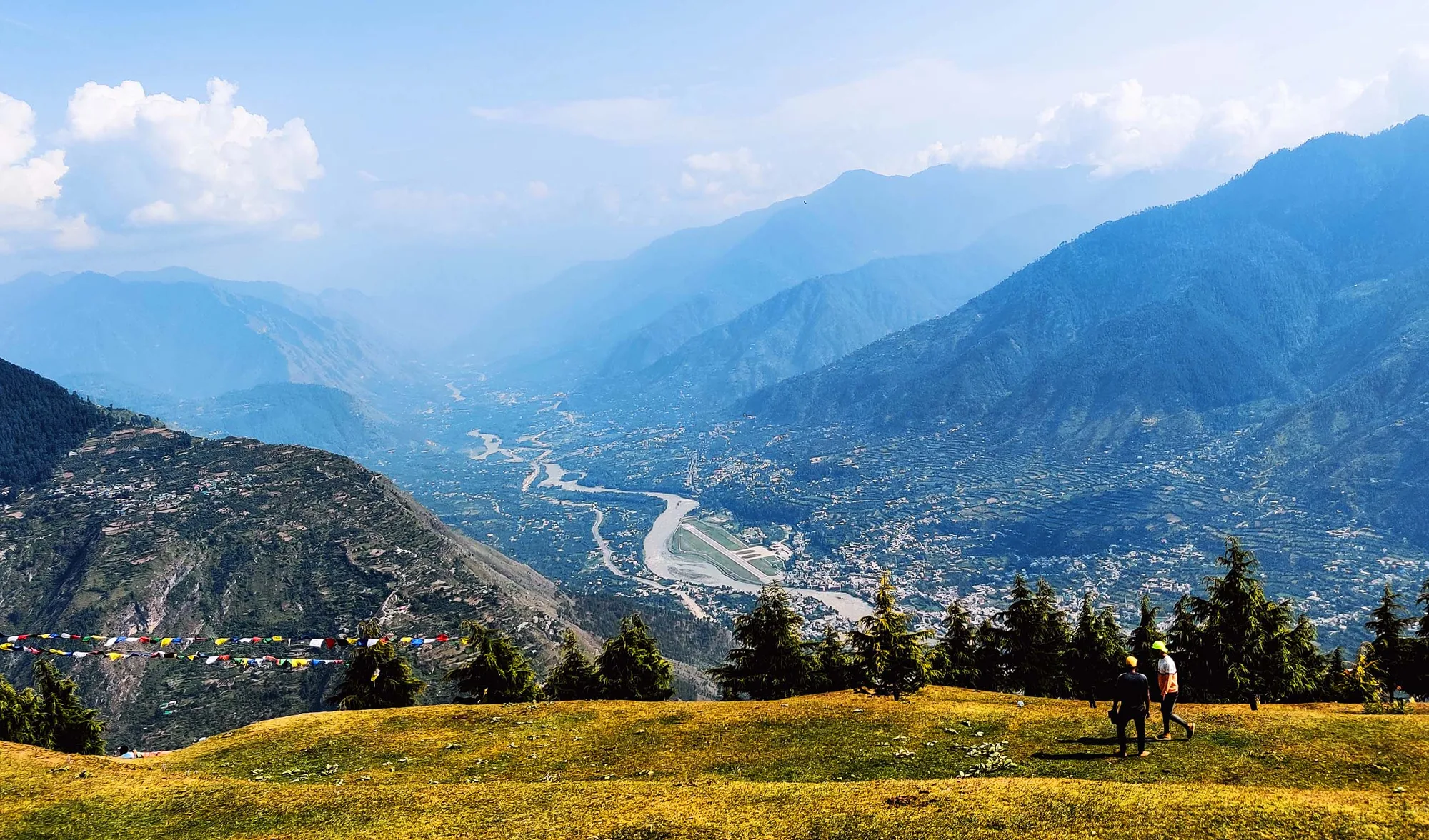
Bijli Mahadev Summit — Beas Valley 180° Panorama
Nicholas Roerich Gallery — Himalayan Paintings in Original Landscape Context
Environment
Nature & Culture
Flora & Fauna
Flora
Fauna
The Bijli Mahadev temple legend is among the most vivid in Himachal Pradesh: in the original mythology, a serpent demon (Kulant) had swallowed the Beas river upstream, blocking its flow and threatening the valley's agriculture. The god Indra killed the serpent with a lightning bolt on this specific summit — and the serpent's body became the mountains surrounding the Kullu valley. The trident at the temple marks the lightning strike point. Every subsequent lightning strike on the temple's trishul is the continuation of this original divine act — the valley's protection renewed by the sky's electricity. The priest's reconstruction of the shattered Shivling after each strike is the ritual reenactment of this founding mythology.
— Local folklore
Spiritual & Cultural Significance
Bijli Mahadev is a highly revered Shiva temple where the main staff attracts lightning to shatter the Shiva Linga, which is then rebuilt with butter.
🕐 Shrine Timings: Open from sunrise to sunset.
Temple Protocols
Technical Details
Challenge & Preparation
Primarily a cardio demand challenge
A welcoming route that balances cardio demand and cumulative fatigue.
Personal Readiness
Am I ready?
Planning
Logistics & Trail Intel
Getting There
Route to Base
Bhuntar Airport (Kullu), 10 km from Kullu town — daily flights from Delhi (1 hr, SpiceJet / Air India)
Kullu town also accessible by bus from Manali (2 hrs), Shimla (8 hrs), and Delhi (12 hrs by Volvo)
Base Village
Kullu town (4,000 ft)
4,000 ft
Last ATM
Kullu town (abundant ATMs). Naggar (no ATM — carry cash from Kullu).
Nearest Medical Facility
Kullu District Hospital (fully equipped, at the start). Naggar CHC on arrival end.
Mobile Signal
Full network coverage throughout the trail.
Water Sources
Bijli Mahadev temple tap (pilgrimage water, potable). Forest trail streams (treat). Patlikuhl village tap. Naggar municipal water.
Charging
Kullu (full grid before start). Patlikuhl guesthouse (grid). Naggar Castle (grid). Zero in forest on Day 2.
For Drivers
Road Condition
Kullu is at the hub of Himachal Pradesh road networks. Kullu to Chansari: 12 km, 30 min. Patlikuhl to Naggar: 6 km, 15 min. Naggar to Bhuntar Airport: 25 km, 1 hr.
Kullu town (abundant petrol stations)
Trail Culinary & Diet
Don't miss the Kullu valley Dham — the traditional Kullu feast served at weddings, festivals, and temple events: a seated meal of madra (chickpeas in yogurt gravy), rajma (mountain kidney beans), khatta (sour tamarind lentil soup), rice, and sepu badi (lentil dumplings in gravy). Dham is served on leaf-plates by community volunteers during Kullu Dussehra at the Dhalpur maidan in enormous quantities — if the walk is timed for the Dussehra window, the communal Dham experience on the maidan below the Bijli Mahadev ridge is the finest food-cultural moment in all of Himachal Pradesh.
Buy specialized diet items at Kullu town (full range of Indian restaurants). Naggar guesthouses offer good Himachali meals. Patlikuhl guesthouse: basic Himachali food.
The Content & Remote Hub
Video Calls
possible at Kullu, Naggar and limited at Bijli Mahadev
Est. 15 Mbps
UPI Reliability
4/10
Base WiFi Available
Permits and Regulations
No permit required. The route crosses standard Himachal Pradesh forest land with public access rights on established paths. Standard HP Forest Department rules apply on the ridge forest sections (no campfire in dry season). The Bijli Mahadev temple has a nominal entry fee for the inner sanctum area (₹20 prasad contribution customary).
Learn more about how we vet operators and ensure transparency on our why MountRoutes page.
Packing List
Light Heritage Walk Kit
- Comfortable trail shoes or light trekking boots with grip (the forest paths have root sections and stream crossings — waterproof sole useful in monsoon fringe months)
- Light daypack (10-12L) — the route has porter/driver support at intermediate points and full luggage doesn't need to be carried
- Camera (wide-angle for forest walk compositions; telephoto for the Kullu valley panorama from Bijli Mahadev summit)
Cultural Context
- Light printed copy of Kullu valley history notes (the Bijli Mahadev temple, Naggar Castle, and Roerich connection are all deeply documented in the HP Tourism archives — reading before the walk transforms the forest traverse into a historical journey)
- Binoculars 8x42 (the Kullu valley view from the ridge walk has some of the finest accessible bird-watching in Himachal Pradesh — Monal, Koklass Pheasant, Lammergeier)
Deep Dives
Explore Further
Editor's Notes
The ideal guide for this walk is not a trekking guide but a Kullu valley cultural guide — someone who can narrate: the story of the Bijli Mahadev lightning mythology and its relationship to the broader Kullu deity network; the history of the Naggar Castle as the political center of the Kullu kingdom before its move south to Kullu town; and the Roerich presence in Naggar as a chapter in the larger story of the Himalaya's influence on Western spiritual art. This cultural guide narrative transforms a pleasant 3-day forest walk into a linear journey through layers of Kullu civilization.
Explore In Detail
Day by Day Itinerary
3-day route reaching 8,070ft. Covers 31km of varied terrain.
→ See full itinerary with altitude profileDifficulty & Fitness
Rated accessible. Well-marked forest paths through dense Deodar and pine trees, transitioning into open meadows.
→ See difficulty breakdown and fitness guideCost & Pricing
Packages range from ₹3,000 – ₹6,000. Inclusions and hidden costs vary by operator tier.
→ See full cost breakdownFrequently Asked Questions
What is Bijli Mahadev and why is it significant?
Bijli Mahadev is a Shiva temple perched on a rocky summit at 8,070 ft above Kullu town, accessible by a 3 km stone-paved path or by the road from Chansari village. The temple is famous throughout Himachal Pradesh for a specific phenomenon: the temple's trident (trishul) is regularly struck by lightning (bijli) during monsoon storms. The legend holds that the Shivling inside the temple absorbs the lightning strike each time, shattering into pieces — after which the priest rebuilds the Shivling from butter and flour before the next strike. The temple has one of the finest panoramic views of the Kullu valley — a 180-degree view of the Beas river sweeping through the valley below, with the Rohtang-Paralkar peaks at the north end. It is a major pilgrimage destination for the Kullu valley communities.
How is the forest walk route structured between Bijli Mahadev and Naggar?
The route descends from Bijli Mahadev (8,070 ft) to the Beas valley floor (4,000-4,500 ft), then crosses to the right bank and follows the forest ridge northward through several mid-altitude forest belts before reaching Naggar (5,774 ft). The walk is not a high-altitude ridge but a forest corridor traverse — relatively gentle on altitude but covering significant ground (28 km over 2 walking days). The local path network through the right-bank forest is known to Kullu valley guides and some shepherd families — it is not marked and not found on hiking maps.
Is there any difficulty in combining this with the standard Bijli Mahadev visit by road?
Most visitors to Bijli Mahadev drive to the Chansari road-end and walk the 3 km stone-paved pilgrim path to the temple — a 1.5 hour round trip. The Forest Walk uses this same path for the Day 1 temple visit, then departs from the standard route by proceeding on the forest track northward rather than returning to the road. The departure point from the pilgrim path is the guide-known junction — invisible without local knowledge.
What is the Roerich connection at Naggar?
Nicholas Roerich (1874-1947) was a Russian artist, explorer, and mystic who made Naggar his home from 1928. His estate — now the Nicholas Roerich Museum — preserves his studio, personal art collection, and the specific viewpoints from Naggar's ridge that he painted repeatedly over 20 years. The walk from Bijli Mahadev arriving at Naggar is an art-geographical journey from the valley's spiritual high point to its artistic high point — these were the two poles of Kullu valley culture that Roerich himself experienced as the primary expressions of the Himalayan spirit.
Can this be done in reverse (Naggar to Bijli Mahadev)?
Yes — the route works equally well in both directions. Starting from Naggar gives the art context (Roerich gallery on Day 1, then forest walk, then Bijli Mahadev pilgrimage on Day 3). Starting from Bijli Mahadev gives the spiritual high point first, then the forest traverse, then the cultural reflection at Naggar. Most guides recommend the south-to-north direction (Bijli Mahadev → Naggar) because the temple's morning light (east-facing, best at 8-9 AM) is worth being at the start.
How long is the forest walk from Bijli Mahadev to Naggar?
The trail connecting Bijli Mahadev to Naggar village is approximately 12 to 14 kilometers long. It mostly involves a long, scenic descent through dense forests and small hamlets.
Is the trail from Bijli Mahadev to Naggar clearly marked?
The trail passes through dense pine and deodar forests and is not always clearly marked. It is highly advisable to take a local guide or use a reliable offline GPS map to avoid getting lost.
What is the best time for the Bijli Mahadev to Naggar forest walk?
The best time is from mid-September to November and March to June. The weather is cool, and the forest canopy provides excellent shade. Avoid the monsoon season due to slippery mud and leeches.
Is the forest walk safe for solo trekkers?
While the forest is beautiful, solo trekking without a guide is not recommended for beginners due to the confusing nature of the forest trails and the occasional presence of wild animals like Himalayan brown bears.
Can this walk be completed in a single day?
Yes, the trek from Bijli Mahadev to Naggar can easily be completed in 5 to 6 hours. Most trekkers start early from Bijli Mahadev and reach the historic Naggar Castle by late afternoon.
Still deciding?
Compare routes side-by-side to find the perfect match for your fitness, dates, and budget.
Everything you need to know, in one place. Someone else in your group needs to see this.
Planning Bijli Mahadev to Naggar Forest Walk?
Get route conditions, operator updates, and season windows before booking.
Don't miss out! Follow us for route updates@mountroutes|LinkedIn
No spam. Only useful trek updates.
Ready to walk this route?
You’ve read the guide, now find the perfect local team to take you there. Compare our verified list of operators.
Compare verified operators