
Explore
Intelligence
Difficulty & Readiness Guide
Is Seven Lakes Dhauladhar Trek Difficult? — Fitness & Altitude Guide
An extreme, highly strenuous expedition involving 60-degree rock scrambles, massive boulder hopping, and crossing a 14,107 ft pass.
The Question
Can I do this trek?
Preparation Required
Advanced
Prior Experience
Required: At least 2-3 moderate Himalayan treks (above 13,000ft).
Expert Verdict
Highly technical trek requiring physical and mental preparation.
Seven Lakes Dhauladhar Trek
Himalayan Placement · Index 54Route Knowledge
Why is it difficult?
Exertion Index
Primary Challenge
Route Identity
Endurance-focused route with significant physical taxation across a pass-crossing route featuring river crossings and scrambling and loose moraine.
Primary Drivers
- Maximum sleeping altitude of 13,500 ft
- Grueling summit push with 3,117 ft of elevation gain
- 6 consecutive high-output trekking days
- Peak daily distance of 13 km
View Full Route Analysis
Physiological Demand
Expect long, exhausting days of sustained climbing at high intensity. Your cardiovascular system will be pushed to its absolute limit.
Multi-day camping requiring mental toughness to handle weather and fatigue debt.
Significant time spent above 12,000ft. Expect shortness of breath and slower pacing.
Rough, uneven trails with occasional scrambling or minor exposure.
Rolling or gradual terrain with minimal harsh impact on joints.
Terrain Breakdown
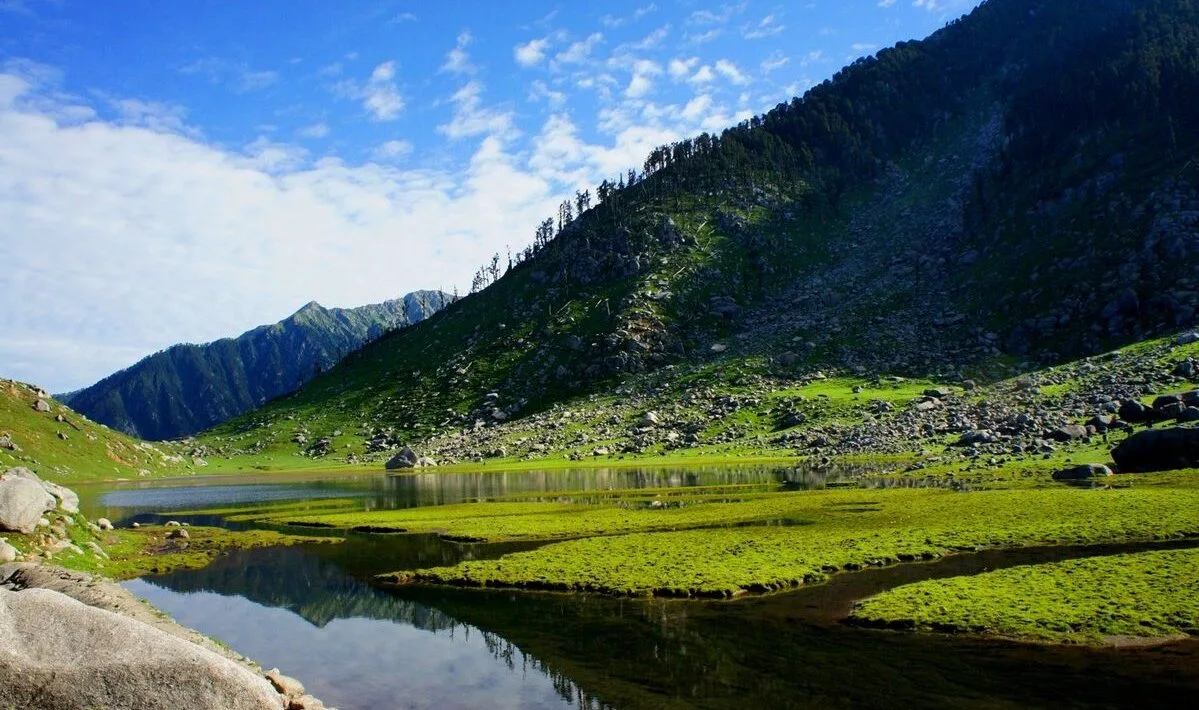
The terrain transitions from forested mud trails to extreme, house-sized boulders between the lakes, and dangerously loose scree on the pass.
Summit Day Notes
The climb to Indrahar Pass requires scrambling on all fours in some sections. A slip here can be fatal.
The Descent
The descents off Indrahar and down to Kareri Lake are notoriously tough on the knees, involving steep, shifting rocks.
Altitude Profile
Aggressive altitude gain on days 2 and 3. The leap from Lahesh Cave to Indrahar Pass tests your acclimatization limits.
Run AMS Risk Audit →Trail Performance Data
Max Gradient
60%
Hydration
1.5L per km recommended
Loose Surface Sections
- •The 2,000 ft scramble to Indrahar Pass
- •The descent from Lam Dal to Kareri
Personal Readiness
Am I ready?
What this route demands
People who feel comfortable on this route can usually:
Who Can Do This Trek?
Min Age
16+
Max Age
55
Western Toilets at Base
Yes
Solo Female Travelers
Culturally safe, but solo trekking of any gender is strictly prohibited due to objective wilderness hazards.
Hazard Profile
What goes wrong?
Common Mistakes on Seven Lakes Dhauladhar Trek
Most injuries and failures on this trail can be avoided by making smarter decisions early on.
Carrying a heavy backpack without prior physical conditioning. The boulder hopping requires balance.
Attempting the traverse without a local guide. There are no trail markers in the high boulder fields.
Not starting early. Afternoon whiteouts and lightning storms are common on the Dhauladhar crest.
Safety & Medical Risks
Key Risks
Severe AMS on the push to Indrahar Pass
Ankle or leg fractures while navigating the massive boulder fields between lakes
Hypothermia if trapped in an afternoon whiteout
AMS (Altitude Sickness)
High risk. The ascent from Lahesh Cave to Indrahar Pass is an aggressive altitude jump. Diamox is highly recommended.
Evacuation Route
If before Indrahar Pass, evacuate back down to McLeod Ganj. If after the pass, you must push forward to Kareri Lake to evacuate via Kareri village. Evacuation from the lakes basin is incredibly difficult.
Solo Trekking
Strictly prohibited by safety standards. Navigation in the boulder fields without a guide often leads to fatal lost-hiker scenarios.
Common Trail Ailments
🏥 Nearest ICU: Dharamshala
Tactical Emergency Hub
> Helicopter evacuation is nearly impossible from the lake basin due to volatile winds. Ground evacuation requires carrying a victim over high passes.
Auditability
How is this calculated?
Understand This Route Further
Before attempting this route:
Still deciding?
Compare routes side-by-side to find the perfect match for your fitness, dates, and budget.
Still think it's doable? Share this with your trek mate and see if they agree.
Step 2: Seasonal Safety
You know how demanding this route is.
Now find the safest and most reliable season to attempt it.
Check Best Time to Go