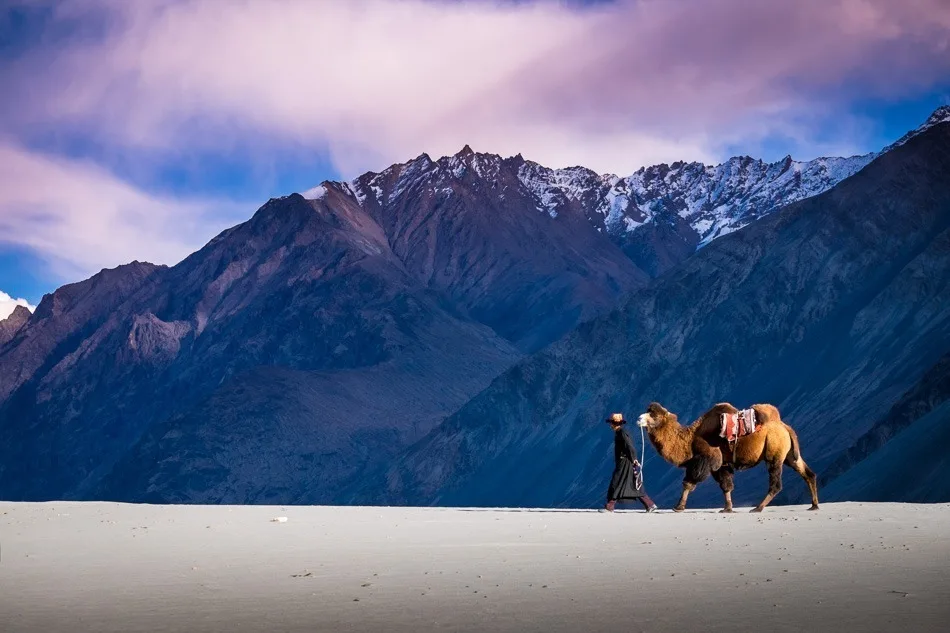
The Nubra Valley Trek is a classic trans-Himalayan crossing linking Leh's Phyang Valley with Hunder in Nubra via the 17,841 ft Lasermo La Pass. Following an ancient caravan route, the expedition traverses remote valleys, high mountain passes, glaciers, and cold desert landscapes. It is one of Ladakh's finest high-altitude trekking experiences for well-acclimatized trekkers.
Trek Highlights
Lasermo La Summit
17,841 ft vantage point overlooking the jagged peaks of the Karakoram.
Hunder Sand Dunes
Surreal silver sand dunes situated against the backdrop of snow-capped mountains.
It is highly challenging. Lasermo La sits at nearly 18,000 ft. The ascent from the South Base involves steep, loose scree, and the descent often requires navigating a small glacier or snowfield. The thin air makes every step exhausting.
Do I need to acclimatize before this trek?
Absolutely mandatory. You must spend a minimum of two to three full days in Leh (11,500 ft) doing light walks before attempting this trek. Moving directly to the 13,000+ ft camps without acclimatization invites severe Acute Mountain Sickness (AMS).
Are there river crossings on this route?
Yes. The descent from the North Base towards Hunder Dok involves crossing glacial melt streams. These must be crossed early in the morning; by afternoon, they swell dangerously with glacial meltwater.
Is this a teahouse trek?
No. This is a pure wilderness expedition. There are no teahouses or permanent settlements between Phyang and Hunder Dok. You must be fully self-sufficient with tents, food, and a dedicated crew/ponies.
Will I see snow on this trek?
Yes, regardless of the month, you are highly likely to encounter snow and ice at the top of Lasermo La. Early season (June) trekkers will face significant snowpack on the pass.
Is there mobile connectivity?
You will have a signal at Phyang (start) and Hunder (end). During the 4 days in the middle of the trek, there is absolutely zero connectivity.
Can I do this without a guide?
No. The route over the pass can be obscured by snow, and the trails in the vast valleys are easily lost. Pack ponies and a local Ladakhi guide who knows the specific terrain and river crossings are essential for survival.
What kind of wildlife might I see?
The high valleys are home to Blue Sheep (Bharal), Marmots, Golden Eagles, and occasionally the elusive Snow Leopard or Tibetan Wolf.
How difficult is the Lasermo La pass crossing?
It is highly challenging. Lasermo La sits at nearly 18,000 ft. The ascent from the South Base involves steep, loose scree, and the descent often requires navigating a small glacier or snowfield. The thin air makes every step exhausting.
Do I need to acclimatize before this trek?
Absolutely mandatory. You must spend a minimum of two to three full days in Leh (11,500 ft) doing light walks before attempting this trek. Moving directly to the 13,000+ ft camps without acclimatization invites severe Acute Mountain Sickness (AMS).
Are there river crossings on this route?
Yes. The descent from the North Base towards Hunder Dok involves crossing glacial melt streams. These must be crossed early in the morning; by afternoon, they swell dangerously with glacial meltwater.
Is this a teahouse trek?
No. This is a pure wilderness expedition. There are no teahouses or permanent settlements between Phyang and Hunder Dok. You must be fully self-sufficient with tents, food, and a dedicated crew/ponies.
Will I see snow on this trek?
Yes, regardless of the month, you are highly likely to encounter snow and ice at the top of Lasermo La. Early season (June) trekkers will face significant snowpack on the pass.
Is there mobile connectivity?
You will have a signal at Phyang (start) and Hunder (end). During the 4 days in the middle of the trek, there is absolutely zero connectivity.
Can I do this without a guide?
No. The route over the pass can be obscured by snow, and the trails in the vast valleys are easily lost. Pack ponies and a local Ladakhi guide who knows the specific terrain and river crossings are essential for survival.
What kind of wildlife might I see?
The high valleys are home to Blue Sheep (Bharal), Marmots, Golden Eagles, and occasionally the elusive Snow Leopard or Tibetan Wolf.
Are you a local operator?
Join our platform to list your verified packages for this trek.