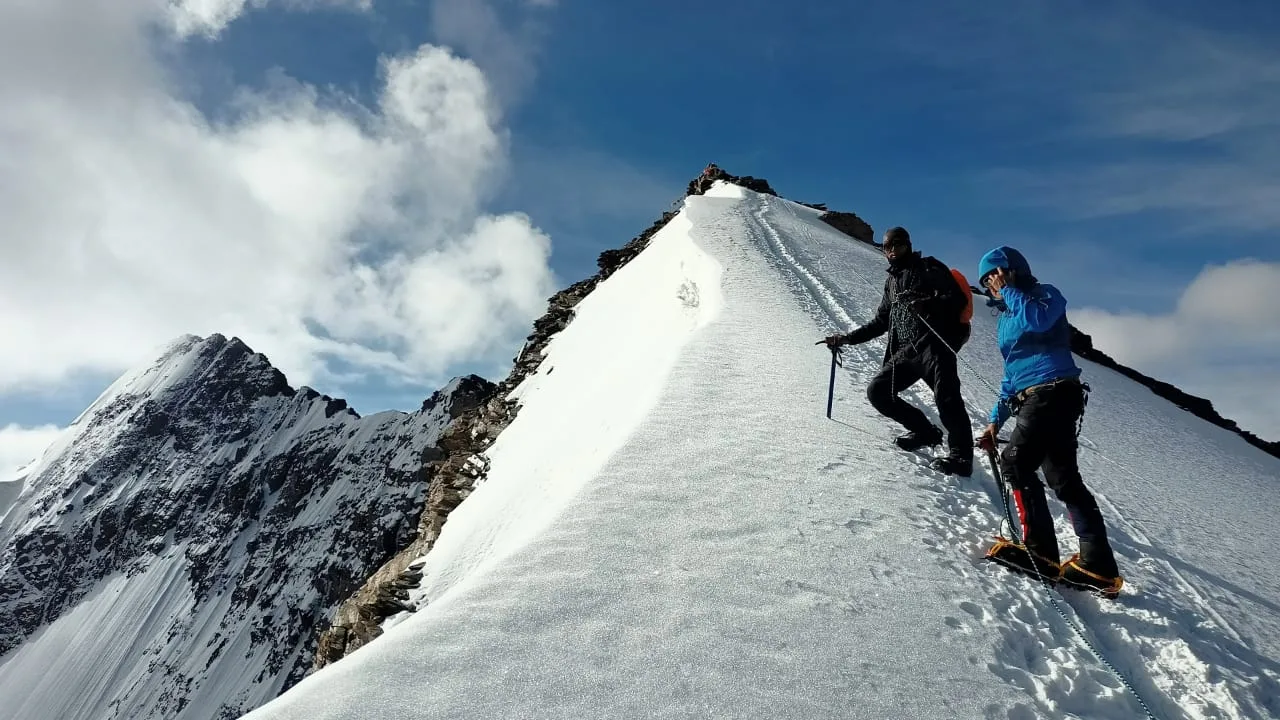
Kang Yatse II Expedition is Ladakh's most popular 6,000-meter trekking peak, offering an ideal introduction to glacier mountaineering in the spectacular Markha Valley.
Expedition Highlights
Yunam Summit (20,046 ft)
Looking down on the entire Chandra-Bhaga range. Even the passing clouds are beneath you.
Do I need prior mountaineering experience for Kang Yatse II?
You do not need formal mountaineering courses. KY2 is classified as a non-technical PD-grade peak, which is a steep snow hike. However, prior experience with high-altitude treks above 15,000 ft (like Roopkund, Pin Bhabha, or Goechala) is strongly recommended.
How different is KY2 from KY1?
KY2 (6,240m) is a non-technical walk-up requiring basic crampon walking on a 30-35° snow slope. KY1 (6,400m) is a highly technical AD+/D- climb requiring technical glacier travel, bergschrund navigation, fixed ropes, and traversing a heavily exposed knife-edge summit ridge.
What is the best month to climb Kang Yatse II?
The ideal window is between July and September. During these months, the Markha Valley is protected from the monsoon by the Trans-Himalayan rain shadow. July offers beautiful snow slopes, while August and September expose more scree but provide firmer, consolidated snow.
What is the summit day difficulty and slope gradient?
The summit climb is physically punishing but technically straightforward. The average slope gradient is around 30° to 35° snow and scree. Altitude is the main obstacle, making every step above 6,000 meters incredibly exhausting.
Is it necessary to spend 2 days in Leh before the expedition?
Absolutely mandatory. Flying directly to Leh (3,500m / 11,500ft) is a massive altitude shock to the body. You must spend the first 2-3 days resting and doing light walks in Leh to acclimatize and prevent acute mountain sickness (AMS).
Is Diamox recommended for the climb?
Many climbers use prophylactic Diamox (Acetazolamide) to aid acclimatization. A slow-ascent itinerary combined with proper hydration is the primary defense, but Diamox can be highly useful. Always consult your physician before starting the dosage.
How cold does it get at Base Camp and during the summit bid?
Night temperatures at Base Camp (5,000m) range from -5°C to -10°C. During the summit push, wind chill can drive temperatures down to -15°C or lower. Double mountaineering boots, a -20°C sleeping bag, and a heavy-duty down parka are essential.
What gear is required for the climb?
While non-technical, you must wear specialized mountaineering boots (semi-rigid or rigid B2/B3 boots), 12-point steel crampons, an ice axe (for balance and self-arrest), a climbing harness, helmet, and safety sling.
What is the source of water on the trail and at camps?
Natural glacial stream water is boiled or chemically treated at Base Camp and lower camps. During the summit push, climbers melt snow at the high camp flats. It is helpful to carry personal chlorine dioxide water purification tablets.
Are there mobile networks or charging points available?
There is zero mobile coverage after leaving Skiu. The last network reception is in Leh and Chilling. There are no charging facilities; climbers must bring high-capacity power banks (at least 20,000 mAh) and keep them warm to retain charge.
Is helicopter evacuation feasible for KY2?
Yes, the Nimaling pasture and Base Camp are flat enough for helicopter landing, subject to military approval and favorable weather. However, a comprehensive medical insurance policy covering high-altitude helicopter rescue is mandatory.
How are baggages and loads transported to Base Camp?
Pack mules and horses transport all group equipment, kitchen supplies, and climbers' main duffel bags up to KY2 Base Camp. Climbers only need to carry a standard daypack (approx. 5-7 kg) containing hydration, rain gear, and personal medication.
Do I need prior mountaineering experience for Kang Yatse II?
You do not need formal mountaineering courses. KY2 is classified as a non-technical PD-grade peak, which is a steep snow hike. However, prior experience with high-altitude treks above 15,000 ft (like Roopkund, Pin Bhabha, or Goechala) is strongly recommended.
How different is KY2 from KY1?
KY2 (6,240m) is a non-technical walk-up requiring basic crampon walking on a 30-35° snow slope. KY1 (6,400m) is a highly technical AD+/D- climb requiring technical glacier travel, bergschrund navigation, fixed ropes, and traversing a heavily exposed knife-edge summit ridge.
What is the best month to climb Kang Yatse II?
The ideal window is between July and September. During these months, the Markha Valley is protected from the monsoon by the Trans-Himalayan rain shadow. July offers beautiful snow slopes, while August and September expose more scree but provide firmer, consolidated snow.
What is the summit day difficulty and slope gradient?
The summit climb is physically punishing but technically straightforward. The average slope gradient is around 30° to 35° snow and scree. Altitude is the main obstacle, making every step above 6,000 meters incredibly exhausting.
Is it necessary to spend 2 days in Leh before the expedition?
Absolutely mandatory. Flying directly to Leh (3,500m / 11,500ft) is a massive altitude shock to the body. You must spend the first 2-3 days resting and doing light walks in Leh to acclimatize and prevent acute mountain sickness (AMS).
Is Diamox recommended for the climb?
Many climbers use prophylactic Diamox (Acetazolamide) to aid acclimatization. A slow-ascent itinerary combined with proper hydration is the primary defense, but Diamox can be highly useful. Always consult your physician before starting the dosage.
How cold does it get at Base Camp and during the summit bid?
Night temperatures at Base Camp (5,000m) range from -5°C to -10°C. During the summit push, wind chill can drive temperatures down to -15°C or lower. Double mountaineering boots, a -20°C sleeping bag, and a heavy-duty down parka are essential.
What gear is required for the climb?
While non-technical, you must wear specialized mountaineering boots (semi-rigid or rigid B2/B3 boots), 12-point steel crampons, an ice axe (for balance and self-arrest), a climbing harness, helmet, and safety sling.
What is the source of water on the trail and at camps?
Natural glacial stream water is boiled or chemically treated at Base Camp and lower camps. During the summit push, climbers melt snow at the high camp flats. It is helpful to carry personal chlorine dioxide water purification tablets.
Are there mobile networks or charging points available?
There is zero mobile coverage after leaving Skiu. The last network reception is in Leh and Chilling. There are no charging facilities; climbers must bring high-capacity power banks (at least 20,000 mAh) and keep them warm to retain charge.
Is helicopter evacuation feasible for KY2?
Yes, the Nimaling pasture and Base Camp are flat enough for helicopter landing, subject to military approval and favorable weather. However, a comprehensive medical insurance policy covering high-altitude helicopter rescue is mandatory.
How are baggages and loads transported to Base Camp?
Pack mules and horses transport all group equipment, kitchen supplies, and climbers' main duffel bags up to KY2 Base Camp. Climbers only need to carry a standard daypack (approx. 5-7 kg) containing hydration, rain gear, and personal medication.
Are you a local operator?
Join our platform to list your verified packages for this expedition.