
Explore
Intelligence
Essential Planning Guide
Mangankot Majhach Lake Trek — Complete Guide (2026)
Vibe & Scenery
The Experience
Introduction
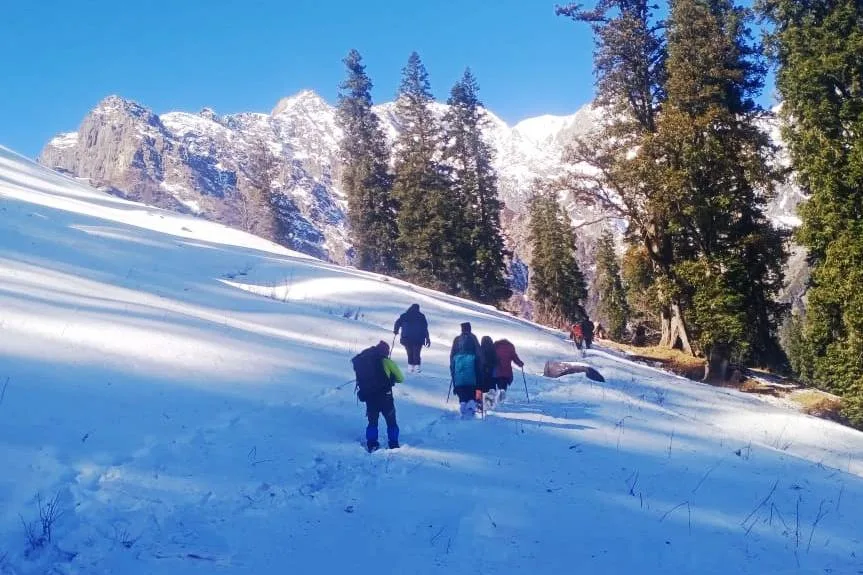
Beginning near Shanag village close to Manali, this trek climbs rapidly through deodar and pine forests before emerging into open alpine meadows surrounding Majhach Lake. Seasonal snow often lingers around the lake well into early summer, adding to its rugged alpine character.
Trekkers with sufficient fitness can continue beyond the lake to Mangankot Ridge, where panoramic views extend across Hanuman Tibba, Friendship Peak, and the surrounding Pir Panjal range.
Although relatively short, the sustained ascent and significant elevation gain make this trek more physically demanding than many weekend routes around Manali.
Quick Facts
Duration
Max Altitude
Difficulty
Best Time
Trek Distance
Trail Atmosphere
Stargazing
Class 2 Dark Sky
Scent Profile
Silence Level
~15 dB
Vertigo Factor
5 / 10
Iconic Spots
Mangankot Ridge
Majhach Lake
Alyias Nallah Forest
Environment
Nature & Culture
Flora & Fauna
Flora
Fauna
The high meadows are traditional summer grazing grounds for the Gaddi shepherds, whose flocks you might encounter in July and August.
— Local folklore
Spiritual & Cultural Significance
Local shepherds view the high ridges as sacred spaces protected by local mountain deities.
Temple Protocols
Technical Details
Challenge & Preparation
Primarily a cardio demand challenge
A capable trekker's route that balances cardio demand and joint & muscle impact.
Personal Readiness
Am I ready?
Planning
Logistics & Trail Intel
Getting There
Route to Base
Take an overnight Volvo bus from Delhi/Chandigarh to Manali
Shanag is a 15-minute auto-rickshaw ride from the Manali bus stand
Base Village
Shanag (Manali)
7,000 ft
Last ATM
Manali
Nearest Medical Facility
Mission Hospital, Manali.
Mobile Signal
Total blackout above Shanag.
Water Sources
Alyias Nallah provides water at base camp. The ridge walk is dry.
Charging
Total blackout.
For Drivers
Road Condition
Overnight Volvo from Delhi to Manali is excellent. The 15-min auto ride to Shanag is on standard paved roads.
Manali
Trail Culinary & Diet
Don't miss the Siddu and local Rajma (in Manali)
Buy specialized diet items at Manali
The Content & Remote Hub
Top Vlog Spots
Video Calls
base_village_only
Est. 15 Mbps
UPI Reliability
4/10
Base WiFi Available
Permits and Regulations
A standard forest entry permit is required by the Himachal Pradesh Forest Department. Do not light campfires near the tree line, as the dry pine needles pose a severe forest fire risk.
Learn more about how we vet operators and ensure transparency on our why MountRoutes page.
Packing List
High-Altitude Clothing
- Fleece mid-layer jacket
- Windproof and waterproof outer shell (Gore-Tex)
- Thermal base layers (essential for cold nights at base camp)
- Quick-dry trekking pants (x2)
- Lightweight down jacket (for evening camp wear)
Footwear & Protection
- High-ankle, waterproof trekking boots (stiff sole)
- Merino wool socks (x3 pairs)
- Waterproof gaiters (mandatory in May/June for snow)
- Camp shoes (lightweight sneakers or crocs)
Head & Hands
- Category 3 UV sunglasses (wrap-around style)
- Warm woolen beanie
- Fleece gloves with waterproof over-mitts
- Wide-brimmed sun hat
Gear & Accessories
- 40-50L backpack with rain cover
- Trekking poles (vital for the steep descent to Shanag)
- 3-season sleeping bag (-5°C comfort)
- Headlamp with spare batteries
- Personal medical kit with blister tape
Deep Dives
Explore Further
Editor's Notes
Explore In Detail
Day by Day Itinerary
3-day route reaching 13,100ft. Covers 21.0km of varied terrain.
→ See full itinerary with altitude profileDifficulty & Fitness
Rated moderate. The trail is roughly 50% steep, root-covered forest floor and 50% rocky, exposed alpine ridge.
→ See difficulty breakdown and fitness guideCost & Pricing
Packages range from 5,500 - 8,500 INR. Inclusions and hidden costs vary by operator tier.
→ See full cost breakdownFrequently Asked Questions
Is this trek suitable for beginners?
No. While it is short (3 days), the gradient from Shanag village to the Mangankot ridge is relentlessly steep. You gain over 6,000 feet of altitude very quickly. It requires strong cardiovascular fitness and prior hiking experience.
How does it compare to Bhrigu Lake?
Bhrigu Lake is highly commercialized and crowded. Mangankot is a raw, unmarked shepherd trail where you are unlikely to see another trekking group. It offers superior solitude but requires a local guide for navigation.
Is there a trail to follow?
In the forest sections, yes. However, above the tree line towards Majhach Lake and the Mangankot Ridge, there is no defined trail. You will navigate via animal tracks and boulders.
Will I see snow on the trek?
If you trek in May or early June, Majhach Lake will likely be frozen, and the approach to Mangankot will require crossing deep snow patches. In September/October, the trail is mostly dry rock and grass.
Is water available on the trail?
Water is plentiful at the base camp near Alyias Nallah. However, the push to Mangankot Ridge is completely dry. You must carry at least 2 liters of water from the lake for the ridge climb.
Will my mobile phone work?
You will have a signal in Shanag village. Once you enter the forest towards base camp, the signal drops completely. Expect a total blackout for 2 days.
Do I need technical gear?
No ropes or ice axes are needed. However, sturdy trekking poles are absolutely essential to protect your knees on the massive descent on Day 3.
Are there wild animals?
The dense pine forests above Shanag are home to Himalayan Black Bears and foxes. Trekking in groups and maintaining a clean campsite is mandatory.
Still deciding?
Compare routes side-by-side to find the perfect match for your fitness, dates, and budget.
Everything you need to know, in one place. Someone else in your group needs to see this.
Planning Mangankot Majhach Lake Trek?
Get route conditions, operator updates, and season windows before booking.
Don't miss out! Follow us for route updates@mountroutes|LinkedIn
No spam. Only useful trek updates.
Ready to walk this route?
You’ve read the guide, now find the perfect local team to take you there. Compare our verified list of operators.
Compare verified operators