
Explore
Intelligence
Detailed Route
Indrahar Pass Trek Itinerary — Day by Day Route & Camps
An intense 4-day technical ascent over the dramatic Dhauladhar range to the towering Indrahar Pass.
Standard RouteThis is the standard mountain pacing for this trek. Specific operators may add an acclimatization day or alter the starting point. Check individual operator schedules for their exact logistics.
Duration
4 Days
Total Distance
28 KM
Max Altitude
14,245 FT
Trek Type
circuit
Day by Day Breakdown
Camp Alt
9,350 ft
Day Gain
+2,519 ft
Reach Triund
Sunset and stargazing at Triund. Brief for the pass push. Technical: Well-paved forest trail. The last 1.5 km (22 switchbacks) is steep. Familiar territory for Triund veterans. Landscape: Triund is the base camp for the Dhauladhar crossing. From here, the snow line of the range is directly above you — a dramatic wall of white. Safety: Hydrate well for the switchbacks. Set up camp by 4 PM.
Key Landmarks
Staying At
The urban settlement of McLeodganj emerges onto a forested ridge ascent.
Camp Alt
11,800 ft
Day Gain
+2,450 ft
Reach Lahesh Cave
Minimal camp. Early sleep for the pass push. Wake-up at 3 AM. Technical: The terrain transforms completely beyond Triund. You climb from the meadow onto steep, rocky slopes. Snow patches begin above 10,000ft in June. The Lahesh Cave is a natural rock overhang that serves as a shelter — not a true cave. Space is very limited (10-12 people max). Some groups camp in tents nearby. Landscape: The Lahesh Cave has been used by Gaddi shepherds for generations as a storm shelter while crossing the Dhauladhar. Charcoal markings on the cave walls tell stories of centuries of crossing. Safety: Critical altitude zone. 11,800ft with high wind exposure. Oximeter check. Layer up — temperatures drop rapidly after sunset. The cave can be damp and cold.
Key Landmarks
Staying At
Crossing the high-altitude pass bridges two distinct watershed systems, shifting the expedition over the glaciated divide and down into a new river basin.
Camp Alt
10,500 ft
Day Gain
-1,300 ft
Today's Objective
🏔 Cross Indrahar Pass
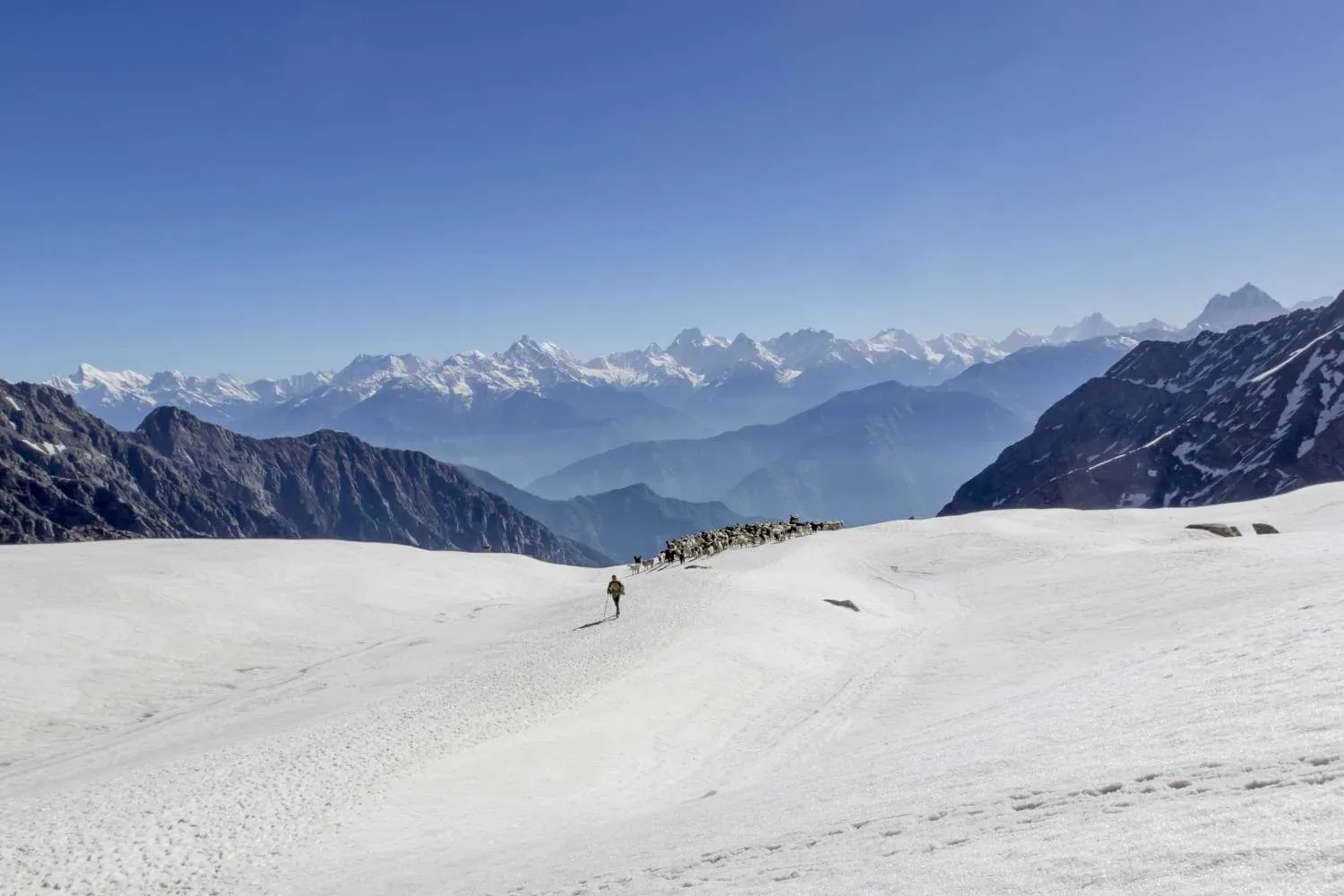
Celebration camp at Chata Parao in the Chamba Valley. Technical: Start at 4 AM with headlamps. The climb to the pass is steep scree and snow. Final ridge is narrow. Microspikes essential in May-June. The pass crest is wind-blasted — 5 minutes for photos. The descent into the Chamba side is steep and technical — loose rock and shifting scree for 4 hours. Landscape: At the pass, you stand on the spine of the Dhauladhar. To your left is the Kangra Valley and Dharamshala. To your right is the Ravi River basin and Chamba. On clear days, the Mani Mahesh Kailash peak is visible to the north. Safety: Turnback time: 11 AM. Wind speeds at the pass can exceed 60 kmph. Do not attempt in poor visibility. The Chamba descent requires careful footing.
Key Landmarks
Staying At
The route crosses the mountain divide, crossing Indrahar Pass into the Ravi river basin.
Field Notes
KEY ACTIONRiver Crossings
Plan to cross early in the day before snowmelt swells the water levels. Unclip backpack waist belts before crossing.
Use Trekking Poles
Trekking poles are highly recommended to save your knees on the descent.
INFOSlower Progress
Progress will be significantly slower and more taxing on your ankles than trail distance suggests.
Camp Alt
3,500 ft
Day Gain
-7,000 ft
Trek to Kuarsi & Drive to Chamba / Dharamshala
Trek concludes. Connect to Chamba, Dalhousie, or return to Dharamshala (6-hour drive). Technical: Long descent through the Chamba forest. Trail is well-defined but steep. Reach road-head and drive to Chamba or back to Dharamshala.
Key Landmarks
The high Ravi alpine basin descends sharply through the forest to the Kuarsi settlement.
Trek Extensions & Add-ons
Chamba Valley Descent
+2 DaysComplete the trans-Himalayan traverse by descending into the Chamba side, ending at Chhatrari village.
Plan Your Trek:
Ready to book? Compare verified operators for Indrahar Pass Trek — transparent pricing, no paid rankings.
Still deciding?
Compare routes side-by-side to find the perfect match for your fitness, dates, and budget.
Day by day, camp by camp. Send this to your group so everyone's on the same page.
Step 4: Cost & Logistics
You understand the route.
Now see what services, permits, and logistics actually cost.
View Cost Breakdown