
Explore
Intelligence
Detailed Route
Kang La Pass Expedition Itinerary — Day by Day Route & Camps
Begins in the lush Miyar valley, transitions to the massive Miyar Glacier, and descends into the stark Zanskar desert.
Standard RouteThis is the baseline pacing strategy for this expedition. Expedition leaders frequently modify rotation schedules, add reserve weather days, or adjust high camps based on real-time mountain conditions. Consult the operator's expedition dossier for their precise approach.
Duration
8 Days
Total Distance
80 KM
Max Altitude
17,940 FT
Trek Type
linear
Permits Required Before You Go
Permit Cost
Where to Get
Keylong / Manali
Documents
Passport/Aadhar, Medical Fitness Certificate
Foreign Nationals
Foreigners may require PAP depending on the exact exit route through Zanskar/Ladakh.
Foreigner Process
Inner Line Permit (ILP) for Spiti — obtain from Shimla or Kaza DC office.
Nearest Embassy Hub
New Delhi
One-Way Traverse Logistics
⚠️ Point of No Return
After Day 5, evacuation is only possible forward towards the destination valley.
Day by Day Breakdown
Camp Alt
11,400 ft
Day Gain
+4,670 ft
Drive to Shukto
A long drive from Manali crossing the Atal Tunnel into Lahaul, turning into the beautiful and remote Miyar Valley.
Key Landmarks
Staying At
The motorable road navigates deeper into the Chandra and Bhaga valleys, where the landscape transitions from lower foothills into the steep, rain-shadow desert.
Camp Alt
12,500 ft
Day Gain
+1,100 ft
Reach Thanpattan
An easy walk through the incredibly flat and wide Miyar Valley, often compared to Yosemite for its towering granite walls.
Key Landmarks
Staying At
The Shukto roadhead emerges onto a desert trail following the Miyar river basin.
Field Notes
KEY ACTIONRiver Crossings
Plan to cross early in the day before snowmelt swells the water levels. Unclip backpack waist belts before crossing.
Camp Alt
13,100 ft
Day Gain
+600 ft
Reach Kesar Yon Chhap
The trail gets rockier as you approach the snout of the Miyar glacier. Seven sacred streams (Kesar Yon Chhap) mark the end of the meadows.
Key Landmarks
Staying At
Vegetation gives way to barren glacial debris as the route enters the expansive moraine basin and ablation zone of the glaciated upper watershed.
Field Notes
KEY ACTIONRiver Crossings
Plan to cross early in the day before snowmelt swells the water levels. Unclip backpack waist belts before crossing.
Camp Alt
14,800 ft
Day Gain
+1,700 ft
Reach Miyar Glacier Camp
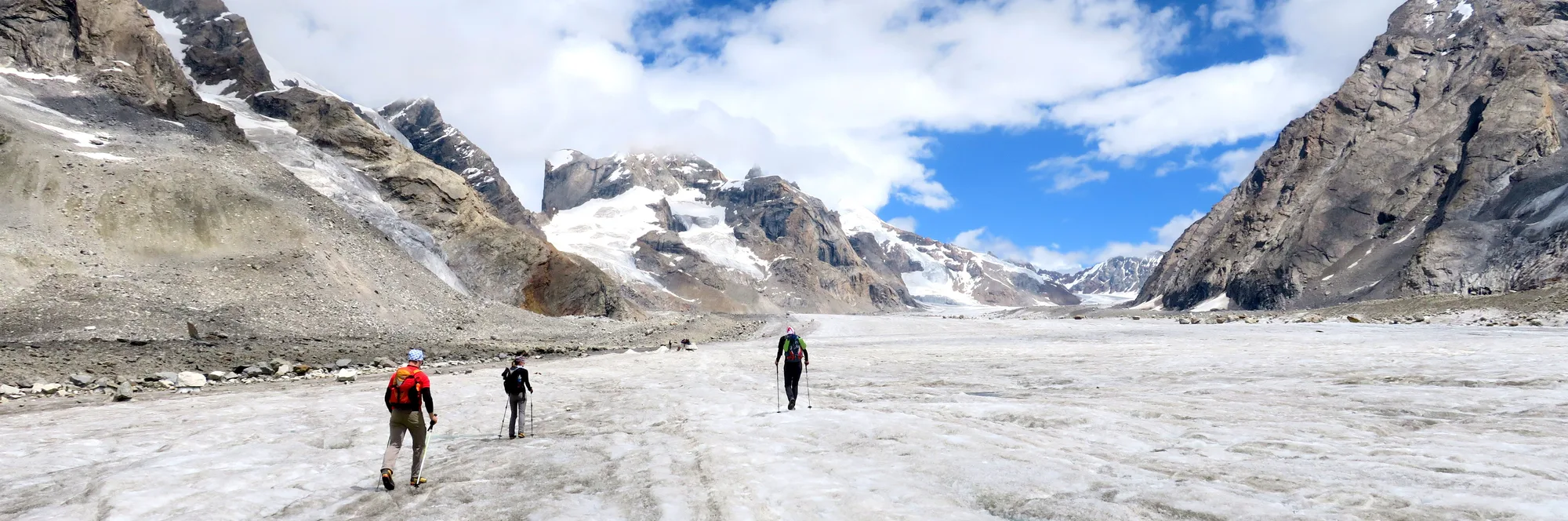
Step onto the Miyar Glacier, one of the longest in the Himalayas (28km). Navigation becomes tricky over hard ice and moraine.
Key Landmarks
Staying At
Crossing the high-altitude pass bridges two distinct watershed systems, shifting the expedition over the glaciated divide and down into a new river basin.
Field Notes
KEY ACTIONRoped Travel
Requires roped glacier travel.
KEY ACTIONStart Early
Start before sunrise to ensure snow bridges remain solid.
KEY ACTIONHelmet Mandatory
Helmet mandatory. Move quickly and quietly through the rockfall zone without stopping to rest.
Use Trekking Poles
Trekking poles are highly recommended to save your knees on the descent.
INFOSlower Progress
Progress will be significantly slower and more taxing on your ankles than trail distance suggests.
Camp Alt
16,000 ft
Day Gain
+1,200 ft
Reach Kang La Base Camp
A long, exhausting day walking entirely on the glacier. Crevasses become more frequent as you approach the base of Kang La.
Key Landmarks
Staying At
Crossing the high-altitude pass bridges two distinct watershed systems, shifting the expedition over the glaciated divide and down into a new river basin.
Field Notes
KEY ACTIONRoped Travel
Requires roped glacier travel.
KEY ACTIONStart Early
Start before sunrise to ensure snow bridges remain solid.
Camp Alt
14,200 ft
Day Gain
-1,800 ft
Today's Objective
🏔 Cross Kang La Pass
Start at 3:00 AM. A steep climb over the vast snowfield to Kang La (17,940 ft). The descent drops dramatically into the Zanskar region.
Key Landmarks
Staying At
The route crosses the watershed at Kang La, dropping into the Zanskar valley.
Field Notes
KEY ACTIONRoped Travel
Requires roped glacier travel.
KEY ACTIONStart Early
Start before sunrise to ensure snow bridges remain solid.
KEY ACTIONHelmet Mandatory
Helmet mandatory. Move quickly and quietly through the rockfall zone without stopping to rest.
Camp Alt
11,800 ft
Day Gain
-2,400 ft
Descend to Bardan / Padum
Descend following the Temasa Nala. The landscape changes to the arid, colorful mountains of Zanskar. Reach the roadhead near Bardan monastery.
Key Landmarks
Staying At
The barren ice and moraine of the upper basin transition quickly back into alpine scrub and alpine meadow basin as the route loses elevation.
Field Notes
KEY ACTIONHelmet Mandatory
Helmet mandatory. Move quickly and quietly through the rockfall zone without stopping to rest.
KEY ACTIONRiver Crossings
Plan to cross early in the day before snowmelt swells the water levels. Unclip backpack waist belts before crossing.
Camp Alt
11,500 ft
Day Gain
-300 ft
Drive to Kargil / Leh
A long, spectacular drive out of Zanskar valley towards Leh or Kargil, marking the end of the expedition.
Key Landmarks
Staying At
The motorable road navigates deeper into the mountain river corridor, where the landscape transitions from lower foothills into the steep, dense forested valleys.
Expedition Extensions & Add-ons
Pin Valley Wildlife Extension
+3 DaysAdd 3 days before the pass crossing for a dedicated Snow Leopard observation camp at 16,500 ft with an experienced Spiti wildlife guide.
Camp-by-Camp Details
Shukto
Start Town
Water
Piped Water
Night Temp
5°C
Toilet
Western/Dry Pit
Miyar Glacier Camp 1
intermediate_camp
Water
Glacier melt
Wind
High
Night Temp
-5°C
Toilet
Leave No Trace
High Camp (Kang La Base)
High Camp
Water
Glacier melt
Wind
High
Night Temp
-12°C
Toilet
Leave No Trace
Temasa Tok
recovery_camp
Water
Stream
Wind
Medium
Night Temp
-2°C
Toilet
Dry Pit
Shukto Homestay / Camp
camp
Thanpattan Meadows
camp
Kesar Yon Chhap Tents
camp
Glacier Camp 1
camp
High Camp Tents (On Ice)
camp
Temasa Tok Tents
camp
Padum Hotel / Homestay
camp
Leh
camp
Navigation & Route Data
Magnetic Declination
+1.6°
Key Waypoints
Critical Navigation Notes
Miyar glacier is 24km long. Navigating the crevasses requires expert route finding. Do not rely solely on GPX.
Plan Your Expedition:
Ready to book? Compare verified operators for Kang La Pass Expedition — transparent pricing, no paid rankings.
Still deciding?
Compare routes side-by-side to find the perfect match for your fitness, dates, and budget.
Day by day, camp by camp. Send this to your group so everyone's on the same page.
Step 4: Safety & Framework
You understand the route.
Now understand the hazards, physiology, and Go/No-Go decision framework.
View Safety Framework