
Explore
Intelligence
Detailed Route
Shrikhand Mahadev Trek Itinerary — Day by Day Route & Camps
A 7-day immersive expedition traversing diverse Himalayan landscapes and alpine altitudes.
Standard RouteThis is the standard mountain pacing for this trek. Specific operators may add an acclimatization day or alter the starting point. Check individual operator schedules for their exact logistics.
Duration
7 Days
Total Distance
34 KM
Max Altitude
17,150 FT
Trek Type
linear
Day by Day Breakdown
Camp Alt
6,000 ft
Day Gain
+3,700 ft
Drive: Shimla to Jaon Village
Registration at yatra committee. Medical check. Gear inspection. Technical: 8-hour drive from Shimla via Nirmand. The road to Jaon is rough. Last ATM at Nirmand. Jaon has basic facilities — no hotels, only dharamshalas and tent stays. Landscape: Nirmand is one of the oldest temple towns in Himachal, with a temple complex that rivals Bharmour. The Parashar Rishi temple here is linked to the same sage as Prashar Lake.
Key Landmarks
Staying At
The route follows the Sutlej river valley before ascending into the forested Nirmand region.
Camp Alt
8,400 ft
Day Gain
+2,400 ft
Reach Singhad
Government medical camp usually at Singhad during yatra. Technical: Very steep forest climb. The trail is narrow and rocky. Multiple stream crossings. In monsoon, the trail is slippery and leech-infested. Cardio is tested from Day 1. Safety: Major altitude gain. Hydrate 4L+. Leech protection mandatory.
Key Landmarks
Staying At
The trail enters a steep, humid and heavily forested gorge environment.
Field Notes
KEY ACTIONRiver Crossings
Plan to cross early in the day before snowmelt swells the water levels. Unclip backpack waist belts before crossing.
Camp Alt
12,200 ft
Day Gain
+3,800 ft
Reach Thachru
Last government medical camp. Summit briefing here. Technical: You cross the tree line today. The trail opens into vast alpine meadows. Snow patches begin above 11,000 ft even in July. Thachru is the last relatively comfortable campsite. Landscape: Thachru means 'the cold place'. Even in July, night temperatures drop to 0°C. The meadow offers views of the Srikhand ridge — a massive wall of rock and ice that dominates the horizon. Safety: AMS zone. 12,500ft. Oximeter check mandatory. Do not overexert. Carry warm fluids.
Key Landmarks
Staying At
Tree line disappears as the valley broadens into a spectacular high-altitude alpine meadow basin, replacing the dense forests with expansive grazing pastures.
Camp Alt
14,400 ft
Day Gain
+2,200 ft
Reach Bheem Dwar
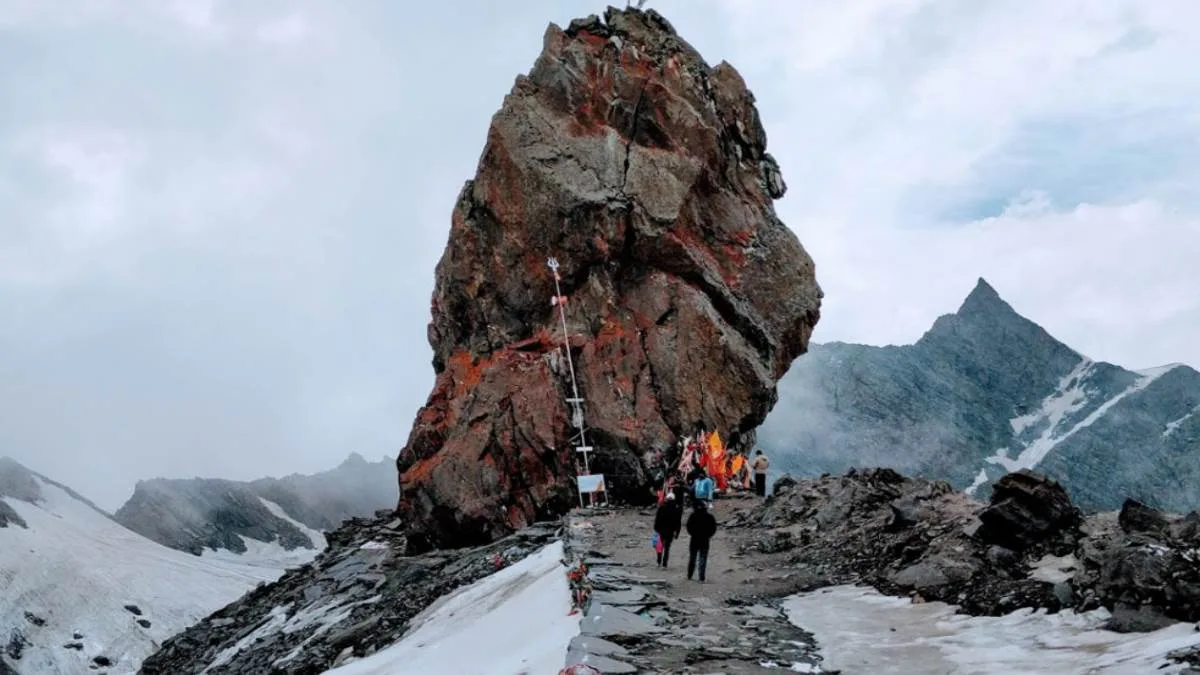
Exposed, windswept camp among boulders. Sub-zero temps. Minimal shelter. This is survival camping. Technical: The terrain transforms completely. Massive boulders — some the size of houses — must be climbed over. The trail is unmarked in many sections. Follow the painted arrows and rope markers. Bheem Dwar is a colossal rock formation that looks like a gateway — you must squeeze through it to continue. Landscape: According to the Mahabharata, Bheem (the strongest Pandava) created this gateway by splitting a mountain with his mace to allow Draupadi to pass. The rocks here are arranged in formations that defy geological explanation. Safety: CRITICAL AMS ZONE. 14,800ft. Oxygen at ~62%. You are sleeping at extreme altitude tonight. Carry Diamox if prescribed. Emergency descent if SpO2 drops below 75%.
Key Landmarks
Staying At
Vegetation gives way to barren glacial debris as the route enters the expansive moraine basin and ablation zone of the glaciated upper watershed.
Field Notes
Use Trekking Poles
Trekking poles are highly recommended to save your knees on the descent.
INFOSlower Progress
Progress will be significantly slower and more taxing on your ankles than trail distance suggests.
Camp Alt
14,400 ft
Day Gain
0 ft
Today's Objective
🏔 Summit Srikhand Mahadev
Alpine start required. Steep and continuous ascent over boulder terrain to the summit. Very long and physically demanding day with significant altitude exposure. Immediate descent after reaching the summit is critical for safety.
Key Landmarks
Staying At
Crossing the high-altitude pass bridges two distinct watershed systems, shifting the expedition over the glaciated divide and down into a new river basin.
Field Notes
Use Trekking Poles
Trekking poles are highly recommended to save your knees on the descent.
INFOSlower Progress
Progress will be significantly slower and more taxing on your ankles than trail distance suggests.
Camp Alt
8,400 ft
Day Gain
-6,000 ft
Return to Singhad
Camp at Singhad. Recovery food and fluids. Technical: Full-speed descent. The body is exhausted from the summit day. The boulder field descent is harder than the ascent — fatigue leads to mistakes. Take extreme care. Reach lower altitude ASAP to recover.
Staying At
The alpine basin transitions back into the upper fringes of the forest.
Field Notes
Use Trekking Poles
Trekking poles are highly recommended to save your knees on the descent.
INFOSlower Progress
Progress will be significantly slower and more taxing on your ankles than trail distance suggests.
Camp Alt
2,300 ft
Day Gain
-6,100 ft
Trek to Jaon & Drive to Shimla
Final descent through forest and village trail to Jaon, followed by a long drive back to Shimla.
The route descends from the forested gorge back into the valley settlement.
Trek Extensions & Add-ons
Bhim Dwar Meditation Stay
+1 DayExtra day at the Bhim Dwar meadow for spiritual meditation and recovery before the final summit push.
Plan Your Trek:
Ready to book? Compare verified operators for Shrikhand Mahadev Trek — transparent pricing, no paid rankings.
Still deciding?
Compare routes side-by-side to find the perfect match for your fitness, dates, and budget.
Day by day, camp by camp. Send this to your group so everyone's on the same page.
Step 4: Cost & Logistics
You understand the route.
Now see what services, permits, and logistics actually cost.
View Cost Breakdown