
We were stuck at Kund with no ride, debating whether to walk 15km to Raasi and destroy our legs before the trek even started.
That's when Manju didi stopped us.
But let me go back a little.
It started as a semester-end trip plan with 5-6 friends. After a lot of excitement, we decided on Kedarnath. We started searching online and even took help from AI. It showed us a simple route and made it look very easy — like we could just go from one place to another without much trouble.
“Don't rely on generic maps or AI that don't know your body. What looks easy on a screen can be relentless on the trail — check your readiness first.”
But in reality, it was not that simple. Because of the huge crowd and increasing number of visitors, the journey had become difficult to manage.
So we changed our plan and decided on Madhyamaheshwar instead.
Then, just 9-10 days before the trip, three friends backed out. In the end, only three of us were left. Managing expenses with a smaller group would be harder — we knew that. But we still decided to go.
That's how we ended up stuck at Kund, three confused engineering students, arguing about whether ₹400 was too much for a local taxi.
That's when Manju didi stopped us.
The Strangers at Kund
Local vehicles were charging around ₹400 per person to go to Raasi. For us, it felt expensive.
We thought of saving money by walking to Raasi via Ukhimath. But Manju didi and Maansi didi — who were also going to Raasi — stopped us and gave us a very important piece of advice:
"If you walk today, your legs will hurt tomorrow, and your actual trek will become much harder."
That moment changed our decision.
They told us their friends were coming in another bus that would go directly to Raasi, but it would take 2 hours to arrive. So we waited with them.
During that time, we had lunch at a small, old dhaba run by an elderly uncle. The food was average, but the warmth and kindness he showed us made it special.
After waiting for around two hours, the bus finally arrived — and it only cost us around ₹90 per person.
That moment taught us a simple lesson: sometimes patience can save you a lot of money.
From 3 to 8
When we boarded the bus, we met their friends — Manish bhaiya, Kusum didi, and later Abhinav bhaiya joined as well. All of them were older than us, working professionals.
We decided to trek together.
Just like that, we went from a group of 3 to a group of 8 — and honestly, this was the best thing that happened on our trip.
We realized this as soon as we reached Gaundaar, the first checkpoint of the trek. Because we were in a bigger group, we shared rooms and split costs, which made everything much cheaper for us. Later, we even shared tents — something very important for students like us.
Another thing we learned: having girls in the group actually helped a lot in negotiating prices. They were naturally good at it, and because of that, we were able to get better deals at multiple places.
At the same time, we also helped them.
Since we had been researching the trek for days, we carried important items — emergency lights, toilet paper, soap paper, and energy-rich food like dry fruits. The other group, being busy with jobs, didn't have time to prepare in detail.
So we balanced each other.
The View That Made Everything Worth It
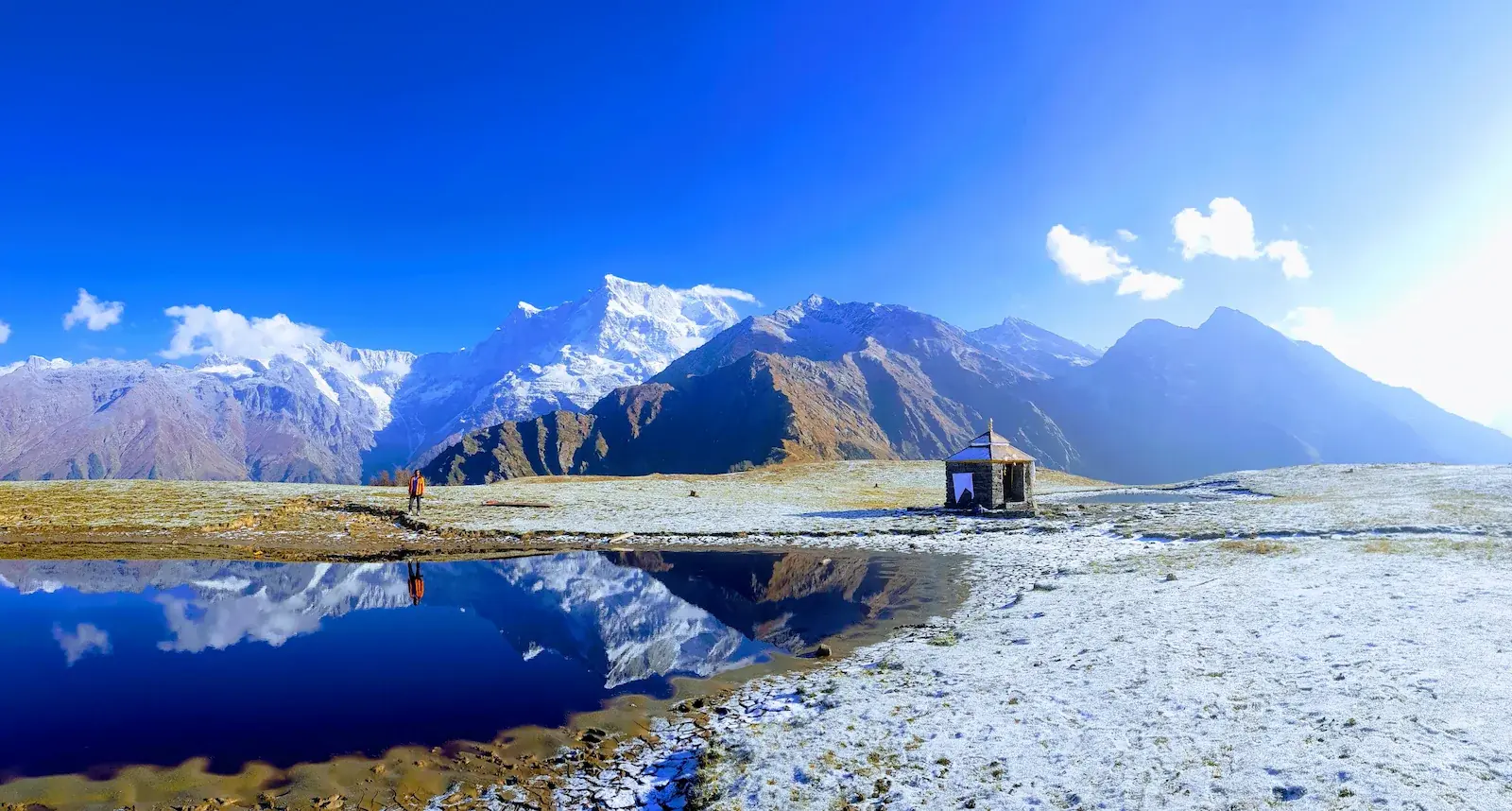
When we finally reached the top and saw the view, it felt completely worth it. All the struggle, confusion, and small problems suddenly didn't matter.
And when we reached Budha Madhyamaheshwar and looked at the mighty Chaukhamba — it felt like it was calling us, pulling us closer.
It was peaceful, powerful, and unbelievably beautiful.
That moment stayed with us.
What We Learned
If you're planning a trek, please don't make the mistakes we made.
Always book transport in advance. Especially in places like Rishikesh — morning buses fill up fast and standing at the bus stand at 5am with no ticket is not a great start.
Don't trust easy routes blindly. Whether it's Google or AI — what looks simple on a map is not always simple on the ground. Talk to people who have actually done it.
Keep your group size balanced. Too small means more expenses per person. We went from 3 to 8 by accident — and it changed everything about the cost and experience.
Don't over-walk before the actual trek. Save your energy for the trail. Manju didi was right. We were almost wrong.
Carry the essentials:
First aid kit — bandages, antiseptic, paracetamol
Energy food — dry fruits, carbs
Basic hygiene items — toilet paper, soap paper
Emergency light
“Being prepared with the right essentials is what kept these students safe. Generate your own custom gear checklist for this route.”
And the biggest lesson:
Be open to meeting new people.
Sometimes, strangers become the reason
your trip becomes easier, cheaper, and
more memorable. We went in as three
friends and came back as eight.
The Himalayas have a way of doing that.
Madhyamaheshwar Trek · August 2025 Group size: started 3, finished 8