
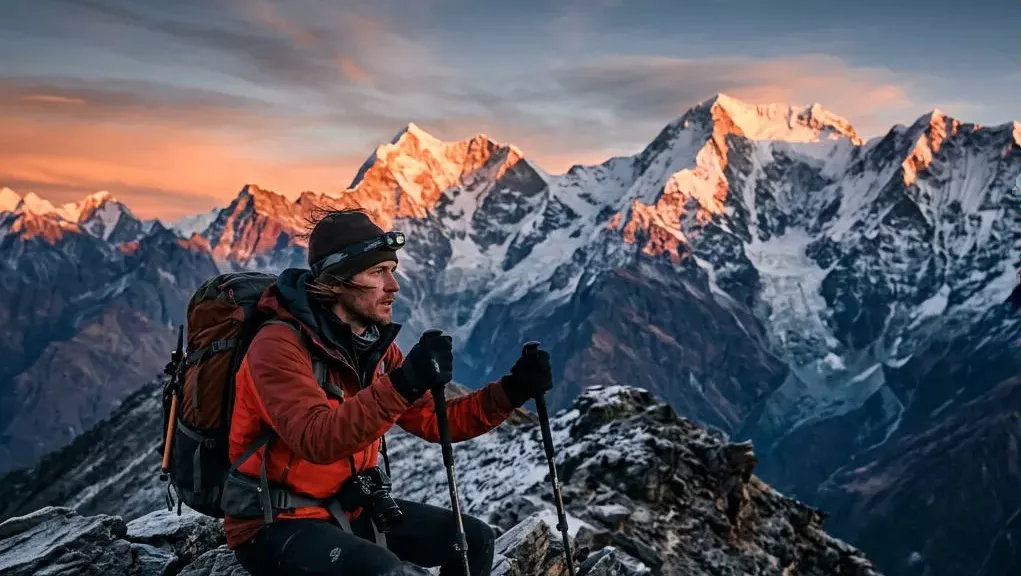
Most people train to reach the top. Mountains demand more than that.
There is a question almost every trekker asks before their first serious route:
How fit do I need to be to make it?
It is a reasonable question. But it is the wrong one.
Mountains do not test you at your freshest. They test you on day six when your sleep has been poor, your appetite is gone, the weather has pushed your summit window by eight hours, and your teammate is moving slower than planned. What you have left at that moment — that is what the mountain actually measures.
This is not about expedition mountaineering. This applies to a five-day trek in the Himalayas just as much as a technical peak. The mountain does not soften simply because your objective is modest.
What Reserve Capacity Actually Means
Reserve capacity is not primarily a fitness concept. It is a safety margin.
When things go according to plan, you will not need it. But mountains rarely follow the plan completely. A storm holds you at camp an extra day. Someone in your group needs help descending. You take a wrong fork and add two hours to an already long day. You wake up nauseated and still have to move.
In each of these situations, the question is not whether you can summit. The question is whether you have enough left to respond.
A self-arrest on a steep snow slope requires explosive strength when you are already tired. An emergency descent requires judgment when your mind is dull from altitude. Waiting out weather in a tent at 4500 metres requires mental steadiness when your body wants to collapse. Helping a struggling teammate requires physical output on top of your own.
None of these are edge cases. They are the normal texture of mountain environments. Reserve capacity is simply the margin between what the mountain asks and what you have available.
“Reserve capacity is the primary buffer against altitude-induced errors. When physical reserves hit zero, cognitive function is the first thing to degrade.”
Why Mountains Amplify Small Problems
At sea level, mild dehydration is uncomfortable. At 4000 metres, it compounds into headache, poor judgment, and early exhaustion.
At sea level, one poor night of sleep costs you focus. At altitude, it costs you coordination, decision-making, and recovery.
A twisted ankle on a city street is inconvenient. On a remote ridge two days from the nearest road, it is a serious situation.
This is not meant to frighten. It is simply how high-altitude, remote environments work. Small deficits stack. Problems that would be minor at home become significant at altitude. The body and mind operating under cold, thin air, physical effort, and accumulated fatigue have less tolerance for additional stress.
This is why experienced mountain people prepare beyond the apparent requirement of their route. Not because they are overcautious. Because they understand that the environment multiplies whatever state you arrive in.
The Summit Is Only Half the Trek
A significant portion of mountain accidents happen on descent.
After the summit. After the effort. After the emotional release. When people are tired, when their attention drops, when they start making decisions on autopilot. When the reserves that were already stretched are now nearly gone.
Training only for the ascent is a misunderstanding of what the mountain actually demands. The return journey requires everything the ascent required, from a body and mind that have already given considerably.
The objective is not to reach the top. The objective is to return safely, with enough left over that you made real decisions rather than forced ones.
“A significant portion of trekking incidents occur during descent, when fatigue and attention drop. Train for the round-trip, not just the peak.”
The Person Who Prepared for the Worst Enjoys the Best
This is something rarely spoken about in trekking culture, but it is consistently true.
When you have trained with margin — when you arrive on the mountain with reserve capacity rather than bare sufficiency — ideal conditions do not just feel manageable. They feel expansive.
The person who trained only enough to reach the summit will spend summit day in survival mode. Every step is a negotiation. Every rest stop is relief. They are reacting to the mountain rather than experiencing it.
The person who trained beyond the minimum will experience the same mountain differently. The same altitude feels workable. The same cold feels tolerable. The mind is clear enough to actually look around — to notice the light on the ridgeline, to have a real conversation at a rest stop, to be present in a place they have worked hard to reach.
The mountain did not change. Their reserve changed.
This is what experienced trekkers and mountaineers mean when they describe difficult routes as manageable. Not that the mountain became easier. But that their margin grew. And with margin comes experience, not just completion.
What This Means for How You Prepare
Training for a Himalayan trek is not gatekeeping. It is not punishment. It is not about reaching some arbitrary fitness standard.
It is about arriving with enough in reserve that the mountain becomes something you experience, not something you endure.
That means cardiovascular base. It means loaded carries if your route has significant elevation. It means back-to-back training days so your body learns to move when already tired. It means taking recovery seriously, because the ability to recover is itself a form of fitness.
It also means understanding your route honestly — not just the distance and elevation, but the remoteness, the altitude profile, the technical sections, the typical weather windows. The mountain does not adjust to what you expected.
A Different Way to Think About It
Most people approach a trek asking: How much fitness do I need to finish?
The better question is: How much will I have left when things do not go according to plan?
That shift in thinking changes how you prepare. It changes how you move on the mountain. And it changes what the mountain gives back to you.
Prepare for the best-case summit. Train for the worst-case mountain.
This piece draws on ideas from Training for the New Alpinism by Steve House and Scott Johnston. If you are serious about mountain preparation, that book is worth your time.